
Water Cleanup in Chicago
Water cleanup in Chicago and surrounding areas. Insurance billing accepted. Call (877) 379-2767.
Standing water does not wait. Within the first hour, it migrates under baseboards, wicks into drywall, and begins saturating subfloor assemblies that may look completely dry from above. By 24 hours, Category 1 clean water can degrade to Category 2 as it picks up contaminants from building materials and soil. The window for a straightforward extraction-and-dry is short, and every hour it closes a little further. That’s the reality of water damage cleanup in Chicago, where older housing stock, clay-heavy soil, and freeze-thaw cycles create conditions that turn a manageable leak into a structural drying project fast.
What water damage cleanup actually involves
Water cleanup is not mopping and running a fan. A proper response starts with understanding where the water went, not just where it’s visible. Moisture meters, thermal imaging cameras, and hygrometers map the true boundary of saturation, which almost always extends further than the visible wet line. In Chicago’s older two-flats and greystones, water behind plaster can read dry at the surface while the lath beneath stays saturated for days.
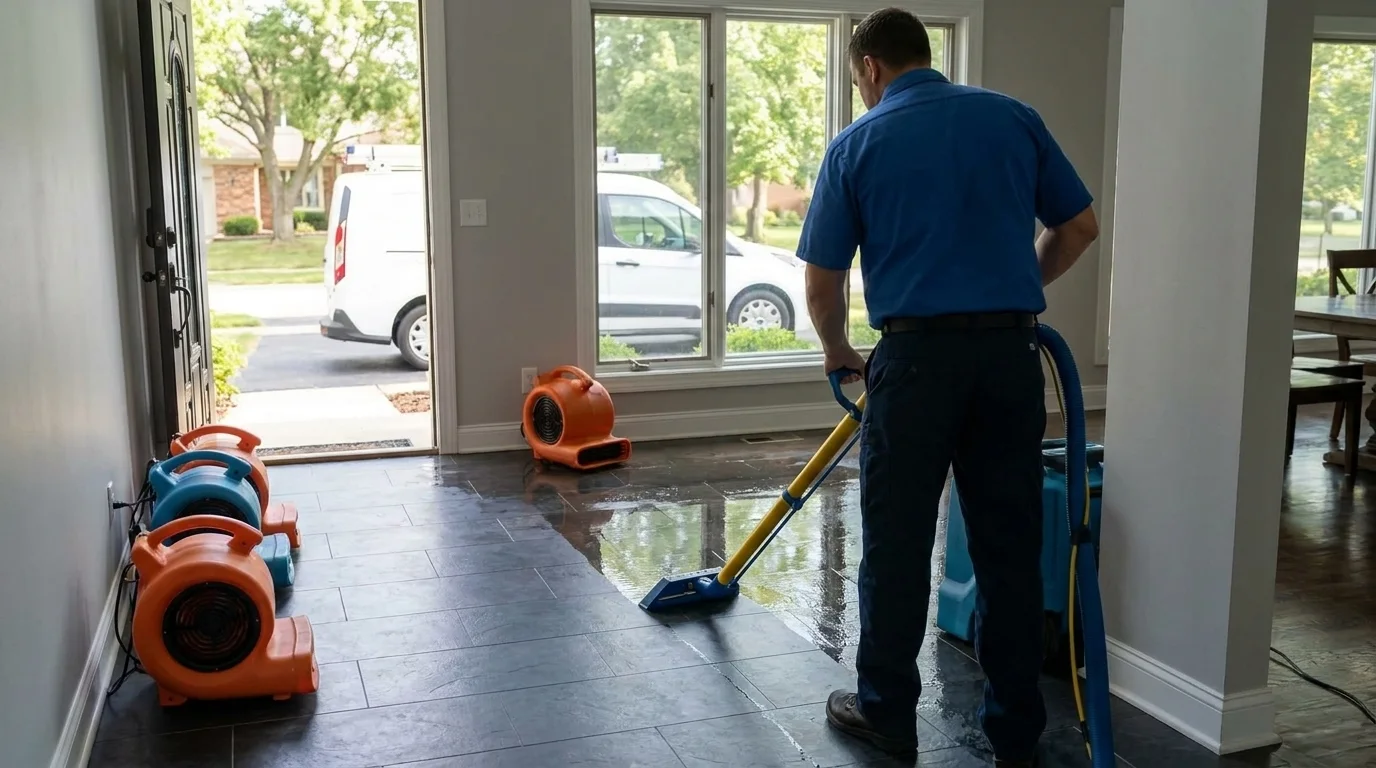
Extraction comes first: truck-mounted or portable extractors pull standing water from hard surfaces and carpet. Then the drying phase begins, industrial dehumidifiers (typically LGR or desiccant units) and high-velocity air movers are positioned based on the moisture map, not guesswork. Equipment placement changes daily as readings shift. The goal is to bring affected materials to their pre-loss equilibrium moisture content without over-drying adjacent materials or creating secondary damage.
For Category 2 (gray water from appliances, sump failure) or Category 3 (sewage, floodwater), containment and antimicrobial treatment are added to the process before drying begins. Porous materials that cannot be dried within the IICRC S500 drying window are typically removed rather than dried in place.
Timeline: most residential water losses with prompt response dry in three to five days. Larger losses, Category 2 or 3 contamination, or delayed response can extend that to seven to ten days or longer.
Our process
-
Moisture mapping and loss assessment, Before a drop of water is extracted, the full extent of saturation is documented using moisture meters and thermal imaging. This establishes the drying goal and the scope of affected materials.
-
Standing water removal, High-capacity extractors remove free-standing water from all affected surfaces. Carpet and pad are evaluated: pad is almost always removed; carpet may be salvageable depending on water category and saturation time.
-
Containment and antimicrobial treatment (Category 2/3), When the water source is a sump backup, appliance drain, or any exterior floodwater, affected areas are contained and treated with EPA-registered antimicrobials before drying equipment is introduced.
-
Structural drying with daily monitoring, LGR dehumidifiers and air movers are deployed to manufacturer specifications and repositioned daily based on moisture readings. Every reading is logged, this documentation matters for your insurance claim and for verifying the drying standard was met.
-
Final clearance and documentation, When all affected materials reach their target moisture content, a final moisture map is produced. This closes the water mitigation phase and hands off a clear scope to reconstruction if materials were removed.
What separates a good water damage response from a bad one
The most common failure in water cleanup is stopping at what’s visible. A crew that extracts standing water, drops two fans, and leaves is not performing structural drying, they’re performing the appearance of it. Drywall that feels dry to the touch can hold 20–30% more moisture than its equilibrium content inside the cavity. That moisture feeds mold within days.
A second common failure: skipping the category assessment. Water from a dishwasher leak that sat over a weekend is no longer Category 1. Treating it as clean water, skipping antimicrobial treatment, leaving porous materials in place, creates a liability for the homeowner and a mold problem that surfaces weeks later.
Insurance adjusters increasingly scrutinize drying logs. A claim without daily psychrometric readings, equipment placement records, and a final moisture map is a claim that can be disputed or underpaid. Thorough documentation is not paperwork overhead, it’s what gets your claim paid correctly.
Finally, Chicago’s older housing stock presents specific challenges: horsehair plaster holds moisture differently than modern drywall, balloon-frame construction allows water to travel vertically inside wall cavities, and original cast-iron drain lines are prone to backup during heavy rain events. Knowing what’s inside the walls before cutting matters.
What does water damage cleanup cost?
Typical costs for residential water damage cleanup vary significantly based on water category, affected square footage, and how quickly mitigation begins. Most homeowners pay somewhere in the following ranges for water mitigation alone, these are industry-typical figures and do not include reconstruction of removed materials.
| Scenario | Typical range |
|---|---|
| Single room, clean water (Category 1), prompt response | $1,200 – $3,500 |
| Multi-room, clean water, prompt response | $3,000 – $7,000 |
| Basement, gray water (Category 2), sump or appliance backup | $4,000 – $10,000 |
| Sewage or floodwater (Category 3), any size | $7,000 – $20,000+ |
| Delayed response with secondary mold growth | Add $2,000 – $8,000+ |
| Crawl space or subfloor saturation | $2,500 – $6,000 |
Every loss is different, and Dry Bros Water & Fire Restoration provides a written scope before work begins, no surprises. Homeowners insurance typically covers sudden and accidental water losses (burst pipe, appliance failure, roof leak from a storm) but excludes gradual leaks and most groundwater flooding; flood damage from rising water generally requires a separate NFIP or private flood policy.
Seasonal and regional considerations
Chicago’s climate creates predictable water damage patterns worth knowing. Freeze-thaw cycles between November and March are the leading cause of burst supply lines in the city’s older building stock, pipes in exterior walls and uninsulated crawl spaces are most vulnerable. Spring snowmelt combined with clay-heavy soil that drains slowly overloads sump systems and backs up through floor drains in finished basements throughout the metro area. Summer storms on the lakefront can overwhelm combined sewer systems, pushing sewage into lower-level units, a Category 3 event that requires a different response than a clean-water pipe break. Knowing the season and the source changes the mitigation approach.
Service area
Dry Bros Water & Fire Restoration serves Chicago and the surrounding metro area, including communities across Cook, DuPage, Lake, and Will counties. Dedicated service-area pages cover specific cities and neighborhoods, each links back here for the full technical detail on how water cleanup works.
If you’re seeing water on the floor right now, call (877) 379-2767 to schedule your moisture assessment and get a written scope before any work begins.
Frequently Asked Questions
Does homeowners insurance cover water damage cleanup and structural drying?
How long does structural drying take after a water loss?
What's the difference between Category 1, 2, and 3 water, and why does it matter for cleanup?
Can water migrate to areas that look completely dry?
What should I do, and not do, while waiting for the water cleanup crew to arrive?
Looking for the best water-cleanup company in Chicago?
Dry Bros Water & Fire Restoration provides water-cleanup in Chicago, IL and the surrounding area. We answer calls 24/7 — call (877) 379-2767 for immediate help.
Need water-cleanup now?
We respond 24/7 across Chicago and surrounding IL cities.