
Water Cleanup in Des Plaines
Water cleanup in Des Plaines, IL. Insurance billing accepted. Call (877) 379-2767.
Our technicians are dispatched from our Chicago, IL headquarters and are typically on-site in Des Plaines within 60 minutes of your call.
Des Plaines sits in a low-lying stretch of Cook County where the Des Plaines River has a long history of overbank flooding, and the flat, clay-heavy soil underneath most of the city drains slowly after heavy rain. When a pipe fails or a sump pump gives out during a storm, water doesn’t just pool, it spreads under flooring, wicks into drywall, and starts working on framing before the smell even registers. Dry Bros Water & Fire Restoration responds to water cleanup calls across Des Plaines, moving fast to stop that spread before it becomes a mold or structural problem.
Why Des Plaines Properties See Water Damage
The geology here works against homeowners. Much of Des Plaines is underlain by glacial clay that resists percolation, so groundwater rises quickly during prolonged rain events. Homes built close to the river corridor, and many in the city’s older residential sections were, often have basements that sit near or below the local water table during wet seasons. Add aging cast-iron drain laterals and the sewer system’s limited capacity during heavy storms, and you get a predictable pattern: basement backups, sump failures, and slow seepage through foundation walls.
The housing stock compounds the risk. A significant portion of Des Plaines homes date from the postwar building boom of the late 1940s through the 1960s. Those houses frequently have original plaster-over-lath interior walls, which behave very differently from modern drywall when wet. The surface can feel dry to the touch within a day or two while the lath and the wall cavity behind it stay saturated for a week or more, long enough for mold colonization to begin.
Our Water Cleanup Process in Des Plaines
The first priority on any water cleanup job is stopping active intrusion and then mapping exactly where moisture has traveled, not just where it’s visible. We use thermal imaging and calibrated moisture meters to trace water migration through walls, under flooring, and into subfloor assemblies. In Des Plaines homes with plaster walls, this step is especially important because surface readings routinely understate actual saturation depth.
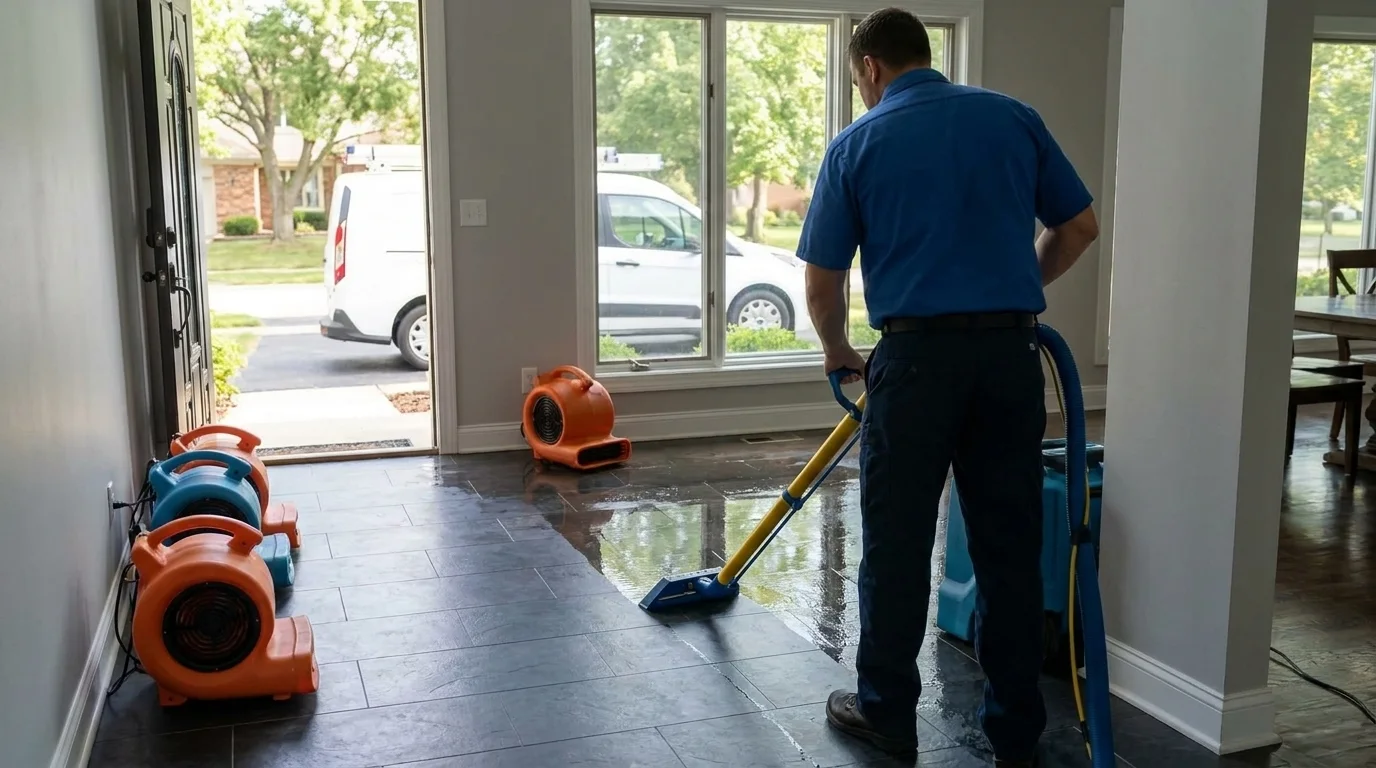
Once we have a complete moisture map, extraction comes next. Standing water is removed with truck-mounted or portable extraction units, depending on access. Structural drying follows using industrial air movers and refrigerant or desiccant dehumidifiers sized to the affected area, not residential box fans. We monitor drying progress with daily readings and adjust equipment placement until materials reach target moisture levels. Nothing gets closed up until the numbers confirm it’s dry.
When building materials are too saturated to dry in place, saturated subfloor panels, swollen baseboards, compromised insulation, controlled demolition removes only what can’t be saved. We document everything photographically before and after, which matters when you’re filing a claim.
Reaching Des Plaines from Chicago
Dry Bros operates out of the Chicago area, and Des Plaines is a direct shot northwest via I-90/94 to I-294, or along the Tri-State corridor. Traffic on those routes is predictable during off-peak hours and heavier during rush windows, we account for that when dispatching. The city’s grid makes most addresses accessible without complicated routing, though some residential streets near the river corridor can have limited turnaround space for larger vehicles. We note that when coordinating equipment staging.
Des Plaines Insurance Coordination
Most homeowner policies cover sudden and accidental water discharge, a burst pipe, a failed appliance supply line, an overflowing fixture, but coverage for groundwater intrusion or sewer backup depends heavily on whether the homeowner carries a separate rider. Des Plaines residents who’ve experienced basement backups tied to the city’s combined sewer system sometimes find standard policies exclude that specific cause. We document the loss origin clearly and thoroughly so your adjuster has what they need to make a coverage determination, and we bill carriers directly when the claim is approved.
Local Note
In the older residential sections of Des Plaines, particularly blocks developed in the late 1940s and 1950s, it’s common to find that finished basements were added after original construction, often with a second layer of drywall applied directly over the original concrete block foundation walls with no air gap. When water enters through the block, it saturates both the block and the drywall simultaneously, but the drywall hides the block’s moisture content from standard surface readings. We probe behind finished surfaces in these situations rather than relying on face readings alone, because closing out a job based on the drywall reading while the block stays wet just moves the mold problem a few weeks down the road.
If you’re dealing with standing water, wet flooring, or a soaked basement in Des Plaines right now, call Dry Bros at (877) 379-2767. The faster water cleanup begins, the more of your home, and your claim, can be saved.
water-cleanup in Des Plaines: Service Coverage
Frequently Asked Questions
How fast can you arrive for water-cleanup in Des Plaines?
How quickly can Dry Bros reach a water cleanup emergency in Des Plaines?
Des Plaines has a history of river flooding and sewer backups, does my homeowner's policy cover that?
My Des Plaines home was built in the 1950s and has plaster walls, does that change how water cleanup works?
What equipment do you use for structural drying after water damage?
How do you handle flood water cleanup in a Des Plaines basement that has a finished wall system over concrete block?
Will my homeowners insurance cover water-cleanup in Des Plaines?
water-cleanup response in Des Plaines
Most Des Plaines calls see a technician on-site within 60 minutes from our Chicago headquarters.