
Water Damage Restoration in Chicago
Water damage restoration in Chicago and surrounding areas. Insurance billing accepted. Call (877) 379-2767.
Standing water doesn’t wait. Within the first hour after a pipe bursts or a sump pump fails, water is already wicking into drywall, migrating under flooring, and soaking into wall cavities where no fan will reach it. By 24 to 48 hours, that hidden moisture becomes the conditions mold needs to colonize. Water damage restoration is the work of stopping that clock, pulling the water out, drying the structure down to its core, and verifying with instruments that what looks dry actually is.
What Water Damage Restoration actually involves
The work is more technical than it looks from the outside. Water removal is the visible part, truck-mounted extractors and portable units pulling standing water from floors, subfloors, and carpet. But the harder problem is what happens after the puddles are gone. Water follows gravity and pressure differentials into places that are invisible to the eye: behind baseboards, inside wall assemblies, beneath hardwood tongue-and-groove, under slab on grade. A surface moisture reading of zero can coexist with saturated lath or a soaked bottom plate.
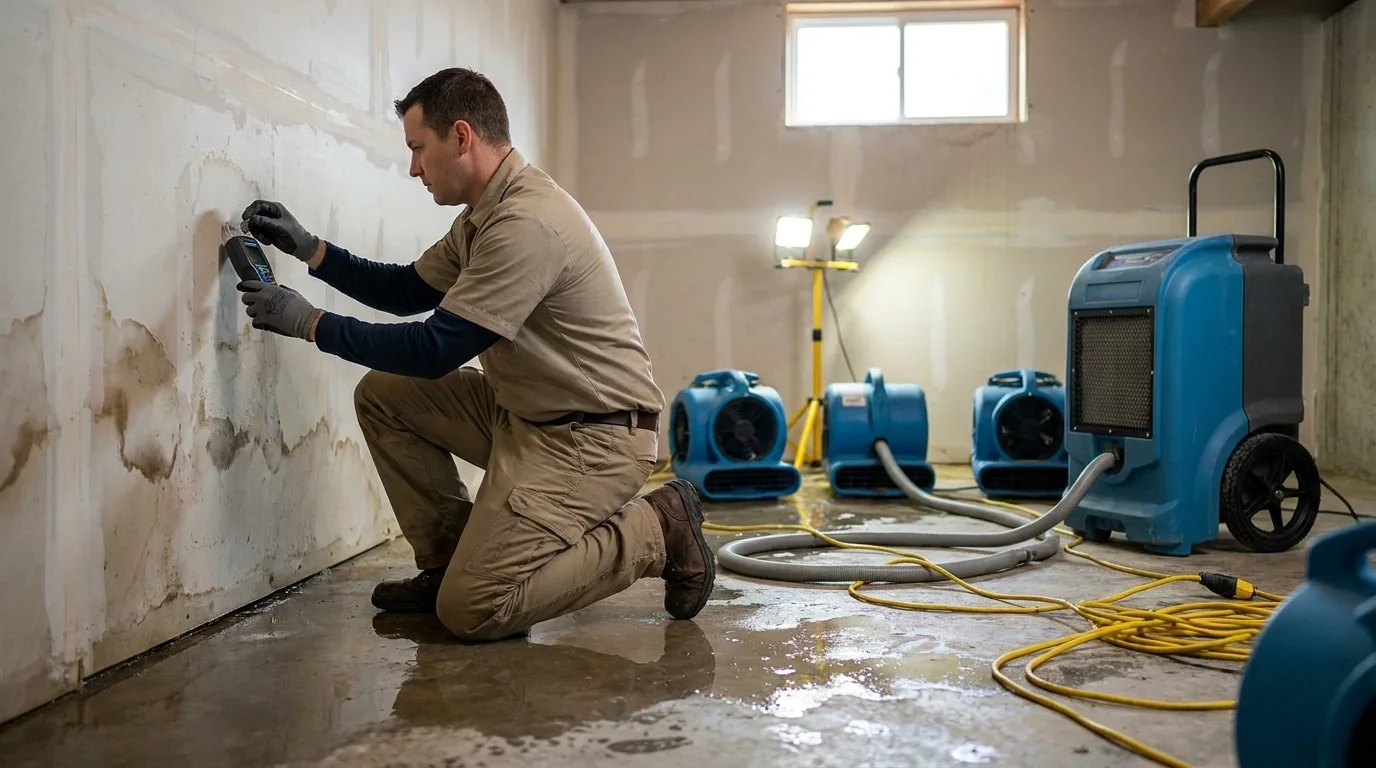
Structural drying uses calibrated desiccant or refrigerant dehumidifiers, axial and centrifugal air movers positioned at specific angles to create airflow across wet surfaces, and in some cases drying mats or injectidry panels to force conditioned air directly into cavities. The goal is to lower the equilibrium moisture content of structural materials, wood framing, OSB, concrete, to a level where microbial growth cannot sustain itself. That target varies by material and ambient conditions, and it is measured with pin-type and pinless moisture meters and psychrometric readings logged daily.
Category of water matters throughout. Clean water from a supply line (Category 1) allows more aggressive open drying. Greywater from an appliance overflow or dishwasher drain (Category 2) requires antimicrobial treatment of affected materials. Blackwater from sewage backup or floodwater (Category 3) typically requires containment, full PPE protocols, and removal of porous materials that cannot be adequately sanitized.
Our process
-
Inspection and moisture mapping. Before any equipment is placed, affected areas are mapped with thermal imaging and moisture meters. This establishes a baseline, where the water traveled, how deep it penetrated, and what materials are involved. The inspection also determines water category and class of loss, which drives every decision that follows.
-
Water extraction. Truck-mounted or portable extractors remove standing and trapped water from hard surfaces, carpet, and pad. Weighted extraction tools press into carpet systems to pull water that standard wands leave behind. Subfloor void spaces are addressed with specialized extraction attachments where access allows.
-
Containment and material assessment (Category 2/3 losses). When the water source is contaminated, affected porous materials, drywall, insulation, carpet and pad, are removed and bagged before drying begins. Containment barriers prevent cross-contamination to unaffected areas. Antimicrobial agents are applied to framing and subfloor surfaces.
-
Structural drying and daily monitoring. Drying equipment is placed per psychrometric calculations, not by guesswork. Readings are logged each day: temperature, relative humidity, specific humidity, and material moisture content at documented locations. Equipment is adjusted as materials dry and conditions change. Drying is not complete until readings reach established dry standards across all affected assemblies, not just the ones easiest to reach.
-
Final documentation and clearance. When all materials reach target moisture levels, a final moisture map is produced. This documentation, equipment logs, daily readings, photo evidence of affected areas, is the record that supports your insurance claim and confirms the structure is ready for reconstruction.
What separates a good water damage response from a bad one
The most common failure in water mitigation is stopping at what’s visible. A crew that extracts standing water, sets a few fans, and returns three days later to pull equipment without daily monitoring is not performing structural drying, they’re performing the appearance of it. Wood framing can read dry at the surface while the center of the member remains well above safe moisture content. Insurers and independent adjusters increasingly request daily psychrometric logs as proof of work; a claim without them is harder to defend.
A second common gap is ignoring the water’s travel path. Water moves toward drains, toward exterior walls, and downward through floor assemblies. A flooded second-floor bathroom can saturate the ceiling assembly below it without a visible stain appearing for days. Thermal imaging during the initial inspection catches migration that moisture meters alone can miss.
Category misclassification is a third failure point. Treating a Category 2 loss as Category 1, skipping antimicrobial treatment, leaving porous materials in place, creates liability and a mold problem that shows up weeks later. Proper documentation of the water source and category protects the homeowner and the contractor alike.
What does Water Damage Restoration cost?
Typical costs for water damage restoration vary significantly based on the size of the affected area, the category of water involved, and whether structural materials need to be removed. Most homeowners pay somewhere in the ranges below for mitigation alone, before any reconstruction:
| Scenario | Typical range |
|---|---|
| Single room, clean water (Category 1) | $1,200 – $3,500 |
| Multi-room, clean water | $3,500 – $7,000 |
| Single room, greywater (Category 2) | $2,500 – $6,000 |
| Sewage backup or blackwater (Category 3) | $4,000 – $12,000+ |
| Finished basement, any category | $5,000 – $15,000+ |
| Crawl space or subfloor saturation | $2,000 – $8,000 |
These are typical industry figures, every loss is different, and Dry Bros Water & Fire Restoration provides a written scope of work before any work begins so you know exactly what is being done and why. Standard homeowners insurance policies generally cover sudden and accidental water damage (a burst pipe, an appliance failure) but typically exclude gradual leaks and ground-level flooding, which requires separate flood coverage through the NFIP or a private carrier.
Seasonal and regional considerations
Chicago’s climate creates a predictable calendar of water damage events. Freeze-thaw cycles in January and February are the peak season for burst pipes, older housing stock in neighborhoods like Logan Square, Bridgeport, and Beverly often has supply lines running through exterior walls or uninsulated crawl spaces that are particularly vulnerable. Spring snowmelt in March and April overwhelms sump pumps and foundation drains, especially in areas with clay-heavy soil that sheds water rather than absorbing it. Summer storms can push water through basement walls and window wells faster than drainage systems can handle. Each season brings a different entry point, but the structural drying process that follows is the same.
Service area
Dry Bros Water & Fire Restoration serves Chicago and the surrounding region, including communities throughout Cook, DuPage, Lake, and Will counties. Individual service-area pages cover specific cities and neighborhoods, if you’re outside Chicago proper, check those pages for local details or call us directly.
If you’re standing in a wet room right now, the most useful next step is a moisture assessment, not a general estimate, but a mapped inspection that shows exactly where the water went and what it will take to dry it out. Call Dry Bros Water & Fire Restoration at (877) 379-2767 to schedule your moisture assessment and get a written scope before any work begins.
Frequently Asked Questions
Does homeowners insurance cover water damage restoration?
How long does structural drying take after water damage?
What's the difference between water extraction and structural drying, and do I need both?
What should I do, and not do, while waiting for the restoration crew to arrive?
How do you know when the structure is actually dry enough, what are you measuring?
Looking for the best water damage restoration company in Chicago?
Dry Bros Water & Fire Restoration provides water damage restoration in Chicago, IL and the surrounding area. We answer calls 24/7 — call (877) 379-2767 for immediate help.
Need Water Damage Restoration now?
We respond 24/7 across Chicago and surrounding IL cities.
Related Coverage
- Our Restoration Services
- Contact Dry Bros Water & Fire Restoration
- Water Damage Restoration in Berwyn
- Water Damage Restoration in Cicero
- Water Damage Restoration in Des Plaines
- Water Damage Restoration in Evanston
- Water Damage Restoration in Naperville
- Water Damage Restoration in Oak Park
- Water Damage Restoration in Skokie
- Burst Pipe Checklist: Step-by-Step Response
- What To Do in the First 24 Hours After Water Damage
- How To Choose a Restoration Company in (Without Getting Burned)