
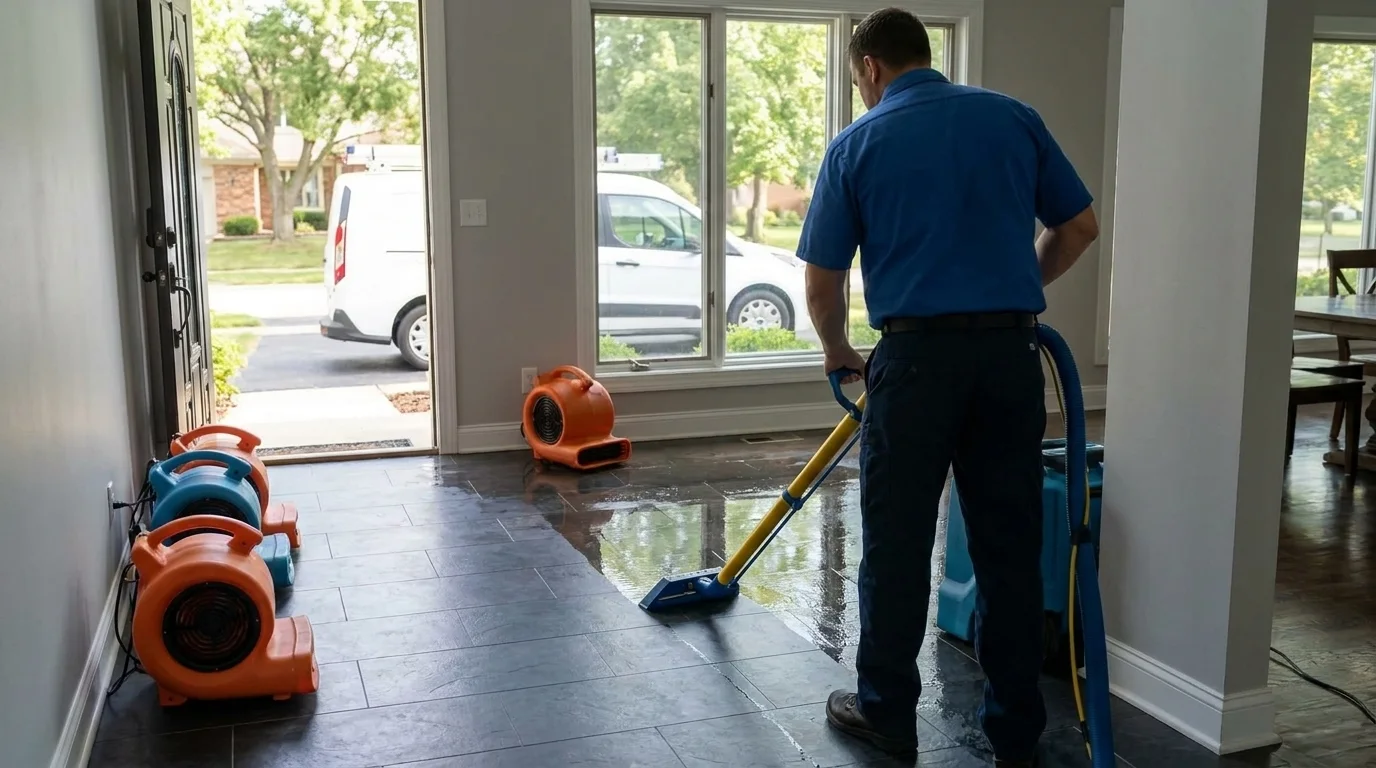
Water Cleanup in Oak Park
Water cleanup in Oak Park, IL. Insurance billing accepted. Call (877) 379-2767.
Our technicians are dispatched from our Chicago, IL headquarters and are typically on-site in Oak Park within 60 minutes of your call.
Oak Park sits on some of the flattest, most clay-dense ground in Cook County, and when a pipe bursts or a storm backs up a basement drain, that clay soil has nowhere to send the water. It pools under slabs, wicks into century-old brick foundations, and saturates the lathe-and-plaster walls that define so much of Oak Park’s architectural character. Dry Bros Water & Fire Restoration responds to water cleanup calls across Oak Park, bringing industrial extraction and drying equipment to homes where the damage is often deeper and slower to release than it first appears on the surface.
Why Oak Park Properties See Water Damage Differently
Most of Oak Park’s residential housing stock was built between the 1890s and the 1940s, the same era that produced its famous Prairie-style architecture. That construction timeline means a lot of homes here have unreinforced brick foundations, original cast-iron or galvanized steel supply lines, and basement floor drains that connect to combined sewer systems. When the Metropolitan Water Reclamation District’s combined sewers surcharge during heavy rain events, a documented pattern across the western suburbs, basement flooding in Oak Park can happen fast, with little warning, and the water that enters is often a mix of groundwater and sanitary backflow.
Beyond the sewer risk, the mature tree canopy that makes Oak Park’s streets beautiful also means aggressive root systems working against clay tile and older PVC lateral lines. A slow root intrusion can go undetected until a drain backs up completely during a storm. The result is standing water in finished basements that were never designed with modern waterproofing in mind.
Our Water Cleanup Process in Oak Park
Water cleanup in an older Oak Park home is not a one-pass job. The process moves in stages because the materials behave differently than modern construction:
Step 1, Source control and safety assessment. Before extraction begins, the water source is identified and stopped. If the loss involves sewer backflow, affected areas are treated as a Category 3 contamination event, which changes the handling protocol for materials and the personal protective equipment the crew uses.
Step 2, Standing water extraction. Truck-mounted and portable extractors pull bulk water from flooring, carpet, and low-lying areas. In basements with original concrete or quarry tile floors, water often pools in grout joints and beneath the slab’s vapor barrier, or in homes old enough to have no vapor barrier at all.
Step 3, Moisture mapping. Thermal imaging cameras and calibrated moisture meters read behind plaster walls and inside balloon-frame wall cavities. In Oak Park’s older homes, balloon framing runs floor-to-ceiling without fire blocking, which means water from a second-floor pipe leak can travel the full height of the wall before it becomes visible at the baseboard.
Step 4, Structural drying. Desiccant and refrigerant dehumidifiers, along with high-velocity air movers, are positioned based on the moisture map, not guesswork. Readings are logged daily until materials reach acceptable dryness levels.
Step 5, Documentation for insurance. Every moisture reading, photo, and equipment placement log is compiled into a report formatted for carrier review.
Reaching Oak Park from Chicago
Dry Bros operates out of Chicago, and Oak Park is a direct run west on I-290 (the Eisenhower Expressway), one of the most direct suburb-to-city corridors in the metro area. The village is compact and well-gridded, which helps crews navigate to addresses efficiently once they exit. If you’re calling from the north end of the village near the Lake Street corridor or from the quieter residential blocks closer to the Harlem Avenue boundary, access is generally straightforward without the staging complications that come with denser urban blocks.
Oak Park Insurance Coordination
Most homeowner policies in Illinois distinguish between sudden and accidental discharge (typically covered) and long-term seepage or flood (typically not covered without a separate flood rider). Oak Park’s sewer backup losses fall into a specific endorsement category, backup of sewers and drains, that not every policy includes. Dry Bros documents the loss origin clearly so your adjuster can apply the correct coverage line. We photograph source conditions, water migration paths, and affected material categories before anything is moved or removed.
Local Note
Oak Park’s plaster walls, common in homes built before World War II, behave very differently from modern drywall during a water loss. Plaster can read nearly dry at the surface with a pin-type meter while the underlying wood lath and the horsehair-reinforced plaster body remain significantly saturated. This means drying timelines in many Oak Park homes run longer than the industry average for comparable square footage, and crews need to monitor readings deeper into the wall assembly rather than relying on surface checks alone. Rushing the drying phase in a plaster home is one of the most common reasons secondary mold growth appears weeks after a cleanup is declared complete.
If you’re dealing with standing water or visible water damage anywhere in Oak Park, call Dry Bros Water & Fire Restoration at (877) 379-2767. The sooner extraction and drying equipment is on-site, the narrower the window for structural damage and microbial growth to take hold in your home’s walls, floors, and framing.
water-cleanup in Oak Park: Service Coverage
Frequently Asked Questions
How fast can you arrive for water-cleanup in Oak Park?
Does Oak Park's older housing stock affect how long water cleanup and drying takes?
My Oak Park basement flooded after a heavy rain, is that covered by homeowner's insurance?
Can sewer backups in Oak Park create a health hazard beyond ordinary water damage?
How does balloon-frame construction in Oak Park homes complicate water damage cleanup?
What should I do immediately after discovering standing water in my Oak Park home?
water-cleanup response in Oak Park
Most Oak Park calls see a technician on-site within 60 minutes from our Chicago headquarters.