
Mold Remediation in Chicago
Mold remediation in Chicago and surrounding areas. Insurance billing accepted. Call (877) 379-2767.
You notice a musty smell in the basement after a wet spring, or a dark patch spreading across the drywall behind a leaking pipe. By the time mold is visible, or you can smell it before you can see it, colonies have typically been growing for 24 to 72 hours. Mold doesn’t pause while you weigh your options. The spores that become visible on a wall surface are often the trailing edge of a much larger hidden growth behind the drywall, inside insulation cavities, or underneath subfloor sheathing.
What mold remediation actually involves
Mold remediation is not mold removal in the sense of wiping a surface clean. The goal is to reduce indoor mold populations to levels consistent with the outdoor baseline, and to eliminate the moisture condition that made growth possible in the first place. Without addressing the moisture source, any cleanup is temporary.
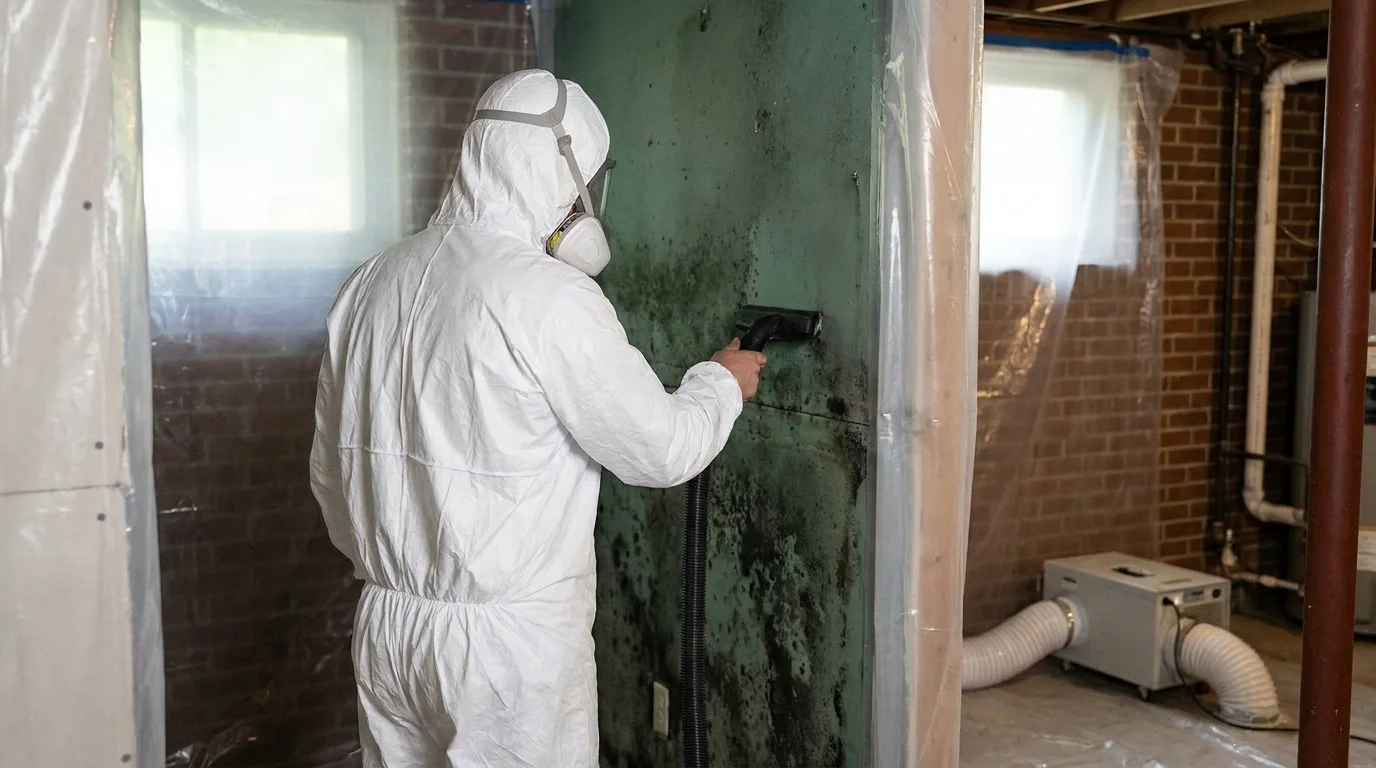
The physical work involves establishing negative-pressure containment zones so that disturbing a mold colony doesn’t spread spores into unaffected rooms. HEPA-filtered air scrubbers run continuously inside the containment area, capturing airborne spores down to 0.3 microns. Affected porous materials, drywall, insulation, wood framing with active surface growth, are typically removed rather than cleaned, because spores embed in the substrate and resist surface-only treatment. Non-porous materials (concrete, metal, glass) can often be cleaned in place using EPA-registered antifungal agents and HEPA vacuuming.
Timeline varies with the size of the affected area and the building materials involved. A single affected wall cavity in a bathroom might be resolved in one to two days. A basement with long-term moisture intrusion and growth across framing, insulation, and OSB sheathing can take a week or more, especially when structural drying of remaining materials is factored in.
Our process
-
Inspection and moisture mapping. Before containment goes up, the full extent of the affected area needs to be defined, including hidden moisture that hasn’t yet produced visible growth. Thermal imaging and pin-type moisture meters identify wet materials behind finished surfaces so the remediation scope covers the actual problem, not just what’s visible.
-
Containment and negative air pressure. Poly sheeting isolates the work zone from the rest of the structure. An air scrubber exhausts through a HEPA filter to the exterior, creating negative pressure that prevents cross-contamination. HVAC registers in the zone are sealed.
-
Controlled demolition and material removal. Affected porous materials are removed, double-bagged in 6-mil poly, and disposed of per applicable waste handling requirements. The goal is to reach clean, dry substrate, confirmed by moisture readings, not by appearance alone.
-
Antifungal treatment and HEPA cleaning. Remaining structural surfaces are treated with EPA-registered antifungal agents and HEPA-vacuumed. This step addresses residual spores on framing and concrete that survived the demolition phase.
-
Clearance verification. Before containment comes down, post-remediation air sampling or surface swab testing confirms that spore counts inside the work zone have returned to acceptable levels. Clearance testing is the only objective way to verify the remediation worked, and it protects the homeowner if questions arise later.
What separates a good mold remediation response from a bad one
The most common shortcut in mold remediation is skipping clearance testing. Without post-remediation sampling, there’s no documentation that the work achieved its goal, and if spore counts remain elevated, the homeowner won’t know until the problem reappears. Reputable operators build clearance testing into the scope; it’s also what insurance adjusters and future home inspectors look for.
A second common failure is treating visible mold without identifying the moisture source. Chicago’s older housing stock, much of it built before modern vapor barriers and drainage standards, is prone to chronic moisture intrusion through foundation walls, around window wells, and through plumbing that runs inside exterior walls. Remediation that doesn’t resolve the underlying moisture condition is a temporary fix.
Containment failures are a third category. Inadequate negative pressure, poly barriers that aren’t sealed at the floor, or failing to seal HVAC registers can distribute spores throughout a home during demolition. This turns a localized problem into a whole-house problem, and it’s expensive to undo.
Finally, watch for scopes that rely on encapsulants rather than removal on porous materials. Painting over mold on drywall or insulation is not remediation.
What does mold remediation cost?
Typical costs for mold remediation vary widely depending on the size of the affected area, the materials involved, and whether structural drying or reconstruction is needed after the mold work is complete. Most homeowners pay somewhere in the ranges below, based on industry-typical figures, these are not Dry Bros Water & Fire Restoration quotes, and every loss is different. Dry Bros provides a written scope of work before any remediation begins.
| Scenario | Typical industry range |
|---|---|
| Single surface area, bathroom or laundry (under 10 sq ft) | $500 – $1,500 |
| Single room, limited material removal | $1,500 – $3,500 |
| Basement with framing and insulation involvement | $3,500 – $8,000 |
| Crawl space remediation | $2,000 – $6,000 |
| Whole-structure or attic mold (large square footage) | $8,000 – $20,000+ |
Homeowners insurance typically covers mold remediation when the growth results from a covered sudden and accidental water loss, a burst pipe, an appliance failure, storm-driven water intrusion. Mold from long-term seepage or deferred maintenance is usually excluded, though the specifics depend on your policy language and carrier.
Seasonal and regional considerations
Chicago’s climate creates a predictable mold calendar. The combination of humid summers and the moisture that lingers after spring snowmelt makes basements and crawl spaces especially vulnerable between April and September. Older homes in neighborhoods like Bridgeport, Pilsen, and Logan Square, many built with rubble-stone or unreinforced masonry foundations, absorb ground moisture differently than poured-concrete construction, and chronic seepage can sustain mold growth year-round even without a discrete water event. Winter brings its own risk: condensation on cold exterior walls and rim joists in under-insulated homes can feed slow-growing colonies that go undetected until spring cleaning.
Service area
Dry Bros Water & Fire Restoration serves Chicago and the surrounding region, including communities throughout Cook, DuPage, Lake, and Will counties. City-specific mold remediation pages cover individual neighborhoods and suburbs, each linking back here for the full process detail.
If you’re seeing visible growth, smelling that characteristic earthy or musty odor, or you’ve had a water event in the last week, call (877) 379-2767 to schedule an air quality assessment. The sooner the moisture source and affected materials are identified, the smaller the remediation scope tends to be.
Frequently Asked Questions
Does homeowners insurance cover mold remediation?
What level of mold contamination requires full containment and negative air pressure?
What is clearance testing, and do I actually need it after mold remediation?
Can mold grow back after remediation?
How do I know whether the dark spots I'm seeing are actually mold or just staining?
Looking for the best mold remediation company in Chicago?
Dry Bros Water & Fire Restoration provides mold remediation in Chicago, IL and the surrounding area. We answer calls 24/7 — call (877) 379-2767 for immediate help.
Need Mold Remediation now?
We respond 24/7 across Chicago and surrounding IL cities.
Related Coverage
- Our Restoration Services
- Contact Dry Bros Water & Fire Restoration
- Mold Remediation in Berwyn
- Mold Remediation in Cicero
- Mold Remediation in Des Plaines
- Mold Remediation in Evanston
- Mold Remediation in Naperville
- Mold Remediation in Oak Park
- Mold Remediation in Skokie
- How To Choose a Restoration Company in (Without Getting Burned)
- How To Test for Mold in Your Home (DIY Kits vs a Pro Inspection)
- 7 Signs You Have Hidden Mold (and What To Do Next)