
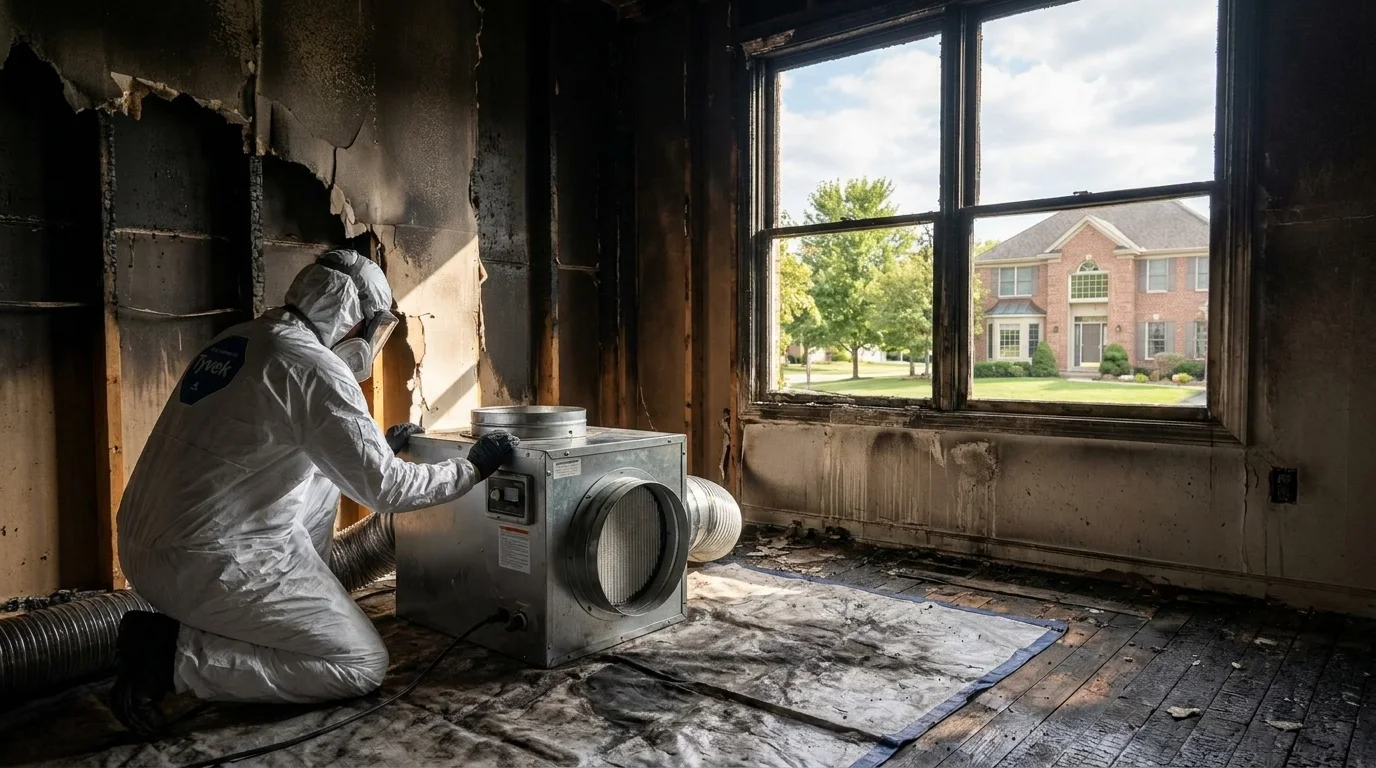
Fire Damage Restoration in Chicago
Fire damage restoration in Chicago and surrounding areas. Insurance billing accepted. Call (877) 379-2767.
Smoke doesn’t stop moving when the flames go out. Within hours of a house fire, soot migrates through HVAC ducts, settles into closets two rooms away from the burn, and begins etching porous surfaces, tile grout, drywall paper, wood grain, in ways that become permanent if they aren’t addressed in the right sequence. The clock on secondary damage starts the moment firefighters leave, which is exactly when most homeowners are still in shock on the front lawn.
What fire damage restoration actually involves
Fire damage is three overlapping problems: structural damage from heat and flames, soot and smoke residue on every surface the smoke touched, and odor molecules that have bonded to materials at a molecular level. Treating any one of those in isolation leaves the other two to worsen.
The work begins with a detailed soot characterization, not all soot behaves the same way. Dry, ashy soot from burning wood or paper smears if you wipe it wrong but responds well to dry-cleaning sponges and HEPA vacuuming. Wet, oily soot from synthetic materials (carpet, foam, plastics) requires alkaline chemical cleaners and a completely different hand pressure and tool set. Protein residue from kitchen fires is nearly invisible but produces some of the most persistent odor of any fire type, and it bonds to painted surfaces in a way that standard cleaning won’t break.
Beyond surface cleaning, structural fire damage often means compromised framing, char-weakened joists, or melted wiring chases that need documentation before any cosmetic work begins. Restoration crews use thermal imaging to find heat-affected cavities that aren’t visible from the surface and moisture meters to check for water intrusion from firefighting efforts, a soaked subfloor under ash is a mold problem waiting to start.
Odor treatment comes last, after surfaces are clean, because applying thermal fogging or ozone to a room that still has soot on the walls is like painting over rust. Done in sequence, these treatments reach the same pathways smoke traveled, wall cavities, ductwork, subfloor gaps, and neutralize odor at the source rather than masking it.
Our process
-
Emergency board-up and site stabilization. Broken windows, compromised roof sections, and unsecured doors are addressed first, both to protect the structure from weather and to establish a secure perimeter before contents work begins.
-
Soot characterization and scope documentation. Every affected room is assessed for soot type, smoke migration path, and structural integrity. Photographs and moisture readings are taken systematically, this documentation becomes the foundation of the insurance claim and the cleaning scope.
-
Contents pack-out and inventory. Salvageable belongings are catalogued, packed, and transported to a controlled facility for cleaning, deodorization, and storage. Items left in a smoke-damaged structure continue absorbing odor; removing them early protects both the contents and the cleaning process.
-
Structural cleaning and deodorization. Surfaces are cleaned in the correct sequence for the soot type present. HEPA vacuuming precedes wet cleaning; alkaline solutions are matched to synthetic residues; dry-cleaning sponges handle friable ash deposits. Once surfaces are clean, thermal fogging or hydroxyl treatment penetrates cavities and porous materials to neutralize odor compounds.
-
Clearance and handoff to reconstruction. The restored space is assessed for residual odor and surface contamination before reconstruction begins. If structural repairs, framing, drywall, flooring, are needed, a documented scope of work is prepared so the rebuild phase starts with a clean, verified baseline.
What separates a good fire damage response from a bad one
The most common mistake in fire cleanup is treating it like a cleaning job rather than a sequenced restoration process. Wiping soot before HEPA vacuuming drives residue deeper into porous surfaces. Painting over smoke-stained drywall without proper sealer application results in bleed-through within months. Skipping contents pack-out means furniture and textiles re-contaminate a freshly cleaned room every time air moves through it.
Insurance adjusters look for a documented scope that distinguishes between affected, restorable, and non-restorable materials, a line-item estimate that separates cleaning labor from structural repair from contents restoration. Adjusters also look for moisture readings taken at the time of loss, because water damage from firefighting efforts is a covered peril that gets missed when the initial documentation focuses only on fire and smoke.
Less experienced operators often skip duct cleaning or treat it as optional. In a structure where the HVAC ran during or after the fire, soot has traveled through the entire duct system. Leaving that residue in place means odor returns every time the system cycles, and the homeowner calls back six months later wondering why the smell never fully left.
What does fire damage restoration cost?
Typical costs for fire damage restoration vary significantly based on the size of the affected area, the type of materials burned, and how far smoke migrated through the structure. Most homeowners pay somewhere between $3,000 and $30,000 for the full scope of fire cleanup and deodorization, with larger losses involving structural repair running considerably higher. The table below reflects typical industry ranges by scenario, every loss is different, and Dry Bros Water & Fire Restoration provides a written scope of work before any work begins.
| Scenario | Typical industry range |
|---|---|
| Single-room kitchen fire, limited smoke migration | $3,000 – $8,000 |
| Multi-room smoke damage, no structural loss | $7,000 – $18,000 |
| Partial structural loss with framing damage | $15,000 – $40,000 |
| Full contents pack-out and off-site cleaning | $2,500 – $10,000 (add-on) |
| Duct system cleaning after whole-home smoke exposure | $800 – $3,500 |
| Total loss with full reconstruction scope | $50,000 – $150,000+ |
Homeowners insurance typically covers fire damage restoration, including cleaning, deodorization, contents pack-out, and structural repair, as a named peril under standard HO-3 and HO-5 policies, subject to your deductible and policy limits.
Seasonal and regional considerations
Chicago’s winters create a compounding problem after a fire: structures that lose windows or roof integrity in January are exposed to subfreezing air within hours. Water from firefighting efforts freezes inside wall cavities, expanding and cracking framing or masonry that might otherwise have been salvageable. Emergency board-up and temporary heat are not optional in a Chicago winter, they’re the difference between a restorable structure and one that deteriorates overnight.
Older housing stock throughout Chicago and its inner suburbs, two-flats, greystones, and bungalows built before the mid-20th century, often have plaster-and-lath wall systems, balloon-frame construction, and unlined masonry chimneys. Balloon framing in particular allows fire and smoke to travel vertically through wall cavities from basement to attic with no fire blocking, which means smoke migration in these homes is almost always more extensive than the burn area suggests. A thorough scope accounts for that travel path.
Service area
Dry Bros Water & Fire Restoration serves Chicago and the surrounding region, including communities across Cook, DuPage, Lake, and Will counties. Individual city pages cover specific service areas in more detail, if you’re outside Chicago proper, check the city pages linked from this service for coverage in your area.
If you’re standing in a smoke-damaged home right now, the next step is straightforward: call (877) 379-2767 to begin smoke and soot removal. The sooner the scope is documented and cleaning starts, the more of your home, and your belongings, can be saved.
Frequently Asked Questions
What's the difference between protein soot and synthetic soot, and why does it change how cleanup works?
Does homeowners insurance cover fire damage restoration?
Why does smoke odor sometimes come back weeks after a fire was cleaned?
What should I do (and not do) in a fire-damaged home while waiting for the restoration crew?
How does contents pack-out work, and is it necessary for every fire loss?
Looking for the best fire damage restoration company in Chicago?
Dry Bros Water & Fire Restoration provides fire damage restoration in Chicago, IL and the surrounding area. We answer calls 24/7 — call (877) 379-2767 for immediate help.
Need Fire Damage Restoration now?
We respond 24/7 across Chicago and surrounding IL cities.
Related Coverage
- Our Restoration Services
- Contact Dry Bros Water & Fire Restoration
- Fire Damage Restoration in Berwyn
- Fire Damage Restoration in Cicero
- Fire Damage Restoration in Des Plaines
- Fire Damage Restoration in Evanston
- Fire Damage Restoration in Naperville
- Fire Damage Restoration in Oak Park
- Fire Damage Restoration in Skokie
- How To Choose a Restoration Company in (Without Getting Burned)
- The Fire Damage Restoration Process, Explained