
Mold Remediation in Oak Park
Mold remediation in Oak Park, IL. Insurance billing accepted. Call (877) 379-2767.
Our technicians are dispatched from our Chicago, IL headquarters and are typically on-site in Oak Park within 60 minutes of your call.
Oak Park’s housing stock tells the story the moment you open a basement door, plaster walls, balloon-frame construction, and crawl spaces that predate modern vapor barriers by half a century. When moisture finds its way into these older structures, whether from a slow pipe leak behind a kitchen wall or seasonal groundwater pressing against an unreinforced foundation, mold can begin colonizing porous materials within 24 to 48 hours. Dry Bros Water & Fire Restoration works in Oak Park specifically because this village demands a different approach than a newer suburb would, one that accounts for the building materials, the basement conditions, and the density of the neighborhood.
Why Oak Park Properties See Mold Issues
Cook County’s clay-heavy soil drains slowly. After a heavy rain, that water doesn’t disappear, it sits against foundation walls, seeps through mortar joints, and pools in crawl spaces beneath homes built long before waterproofing membranes were standard. Oak Park’s grid of mature tree canopy is beautiful, but root systems that have grown for decades can compromise drain tile and redirect surface water toward foundations rather than away from them.
The village’s housing stock skews heavily toward pre-1940 construction. Balloon-frame walls, where studs run continuously from the foundation sill to the roof, create uninterrupted vertical channels for water to travel. A roof leak or an ice dam along a gutter line doesn’t stay in the attic; it can wick downward through wall cavities and show up as mold behind first-floor baseboards weeks later, long after the original water source has dried. Plaster-on-lath walls compound the problem: the surface can feel dry to the touch while the wood lath behind it remains saturated and actively supporting mold growth.
Our Mold Remediation Process in Oak Park
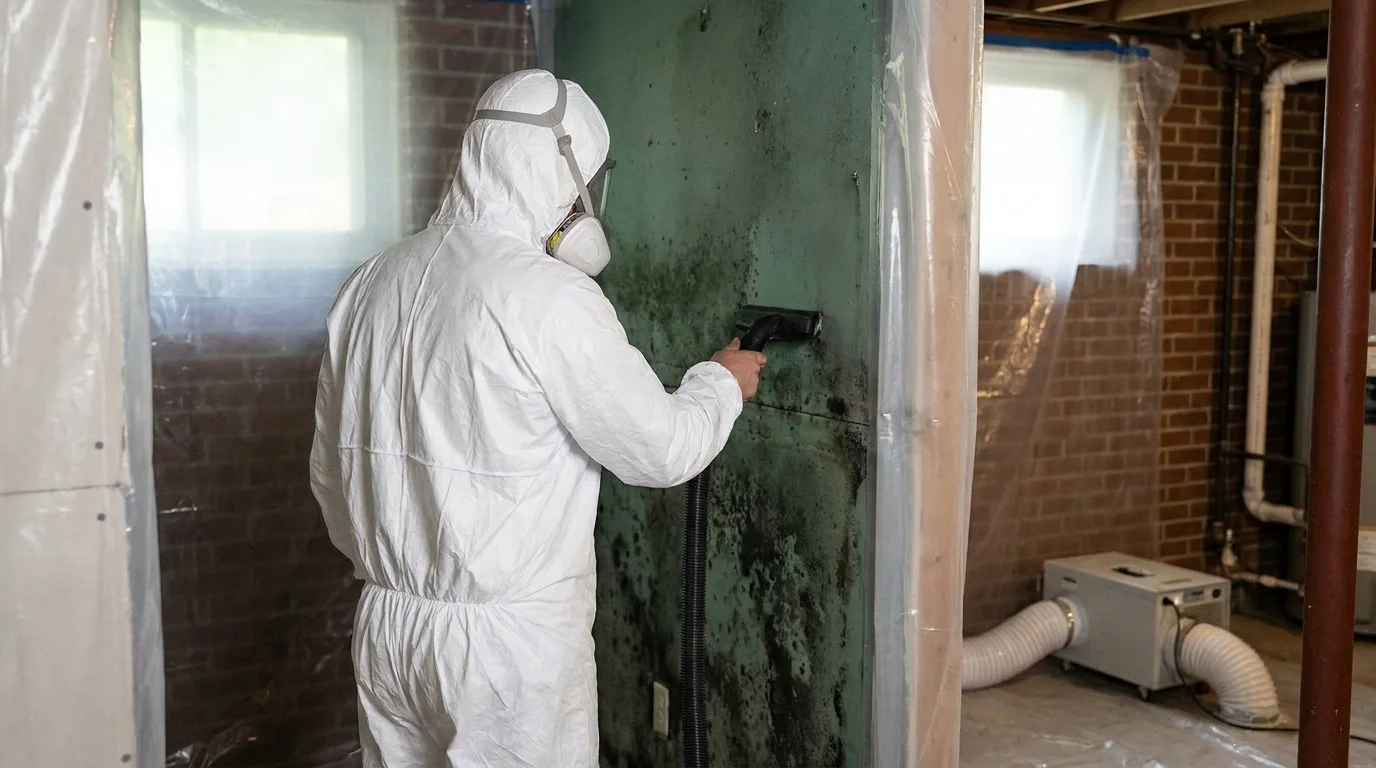
Remediation here starts with containment, not cleaning. Before any disturbed material becomes airborne, the affected area is sealed with poly sheeting and placed under negative air pressure using HEPA-filtered air scrubbers. This matters especially in Oak Park’s attached and semi-detached homes, where a shared wall with a neighbor’s unit means spores can travel through gaps around plumbing penetrations or electrical chases if containment is skipped.
Once containment is established, affected materials, drywall, insulation, wood framing, are removed to the extent necessary to reach clean, unaffected substrate. In plaster-wall homes, this step requires more precision: plaster is dense and often salvageable if the lath behind it is structurally sound and the moisture reading has returned to baseline. We use moisture meters and thermal imaging to map the actual boundary of the affected zone rather than guessing by visual inspection alone.
After removal, surfaces are treated with an EPA-registered antimicrobial agent and allowed to dry fully before any reconstruction begins. Final air quality is verified before the containment barrier comes down.
Reaching Oak Park from Chicago
Dry Bros operates out of Chicago, and Oak Park sits directly on the western edge of the city, the two are separated by Austin Boulevard, not by any meaningful distance. The Eisenhower Expressway (I-290) puts crews into the heart of Oak Park quickly, with exits at Harlem Avenue and Oak Park Avenue serving the village’s core neighborhoods. For addresses in the northern reaches of the village, the Tri-State Tollway approach via I-294 and North Avenue is often faster during peak hours.
Because Oak Park is a dense, walkable village with narrow side streets and on-street parking, crews coordinate access before arriving on jobs where equipment staging, air movers, dehumidifiers, negative-air machines, needs to be planned around parked cars and sidewalk clearance.
Local Note
Oak Park homes built before 1978 frequently contain lead paint, and many also contain asbestos in floor tile, pipe insulation, or textured ceiling coatings. When mold remediation requires disturbing those materials, cutting into a plaster ceiling, removing vinyl floor tile to reach a wet subfloor, the scope of work changes. Abatement of lead or asbestos is regulated separately from mold remediation under Illinois EPA guidelines, and the two scopes cannot simply be combined into one crew’s work without proper handling protocols. When we scope a job in an older Oak Park home and suspect regulated materials may be present, we flag it before work begins so the homeowner isn’t caught off guard mid-project.
If you’re dealing with visible mold growth, a persistent musty odor in a basement or closet, or a water loss that wasn’t fully dried out, call Dry Bros at (877) 379-2767. Oak Park’s older homes don’t forgive deferred mold problems, the longer colonization continues in a balloon-frame wall cavity, the more framing material is at stake.
Mold Remediation in Oak Park: Service Coverage
Frequently Asked Questions
How fast can you arrive for mold remediation in Oak Park?
Are Oak Park's older balloon-frame homes more vulnerable to hidden mold than newer construction?
How does Cook County's clay soil affect mold risk in Oak Park basements?
Does mold remediation in Oak Park require any village permits or post-remediation inspections?
What does the mold remediation process actually look like inside an Oak Park home?
Can Dry Bros handle mold remediation in Oak Park's attached or semi-detached homes without affecting neighboring units?
Will my homeowners insurance cover mold remediation in Oak Park?
Mold Remediation response in Oak Park
Most Oak Park calls see a technician on-site within 60 minutes from our Chicago headquarters.