
Mold Remediation in Des Plaines
Mold remediation in Des Plaines, IL. Insurance billing accepted. Call (877) 379-2767.
Our technicians are dispatched from our Chicago, IL headquarters and are typically on-site in Des Plaines within 60 minutes of your call.
Des Plaines sits in a part of northeastern Illinois where the soil holds moisture long after a rainstorm passes, and where basements in homes built during the postwar building boom of the 1950s and 1960s were often finished with materials that had no real resistance to humidity. When a slow pipe leak, a sump pump failure, or a backed-up floor drain goes unaddressed for even 48 to 72 hours, that combination of damp soil pressure and older construction creates exactly the conditions mold needs to colonize wall cavities, floor joists, and HVAC chases. Dry Bros Water & Fire Restoration provides mold remediation in Des Plaines for homeowners and property managers dealing with that reality.
Why Des Plaines Properties See Mold Issues
The Chicago metropolitan area’s freeze-thaw cycle is hard on foundations, and Des Plaines is no exception. Ground movement through winter and spring creates hairline cracks in block and poured-concrete basement walls, cracks that let groundwater seep in slowly enough that a homeowner might not notice until a musty smell appears in a finished basement or a discolored patch shows up on drywall. The Des Plaines River corridor adds another layer: properties near the river have historically dealt with periodic flooding, and even homes several blocks away can experience elevated water tables after significant rainfall events.
The housing stock compounds the problem. Many homes in Des Plaines were built between the late 1940s and early 1970s, when fiberglass batt insulation and paper-faced drywall were standard. Both materials are highly susceptible to mold growth when they stay wet. Older plumbing, galvanized steel and early copper with lead-soldered joints, is more prone to pinhole leaks inside wall cavities, where moisture can accumulate for months before it becomes visible. By the time a homeowner smells something, the mold colony is often well established behind the surface.
Our Mold Remediation Process in Des Plaines
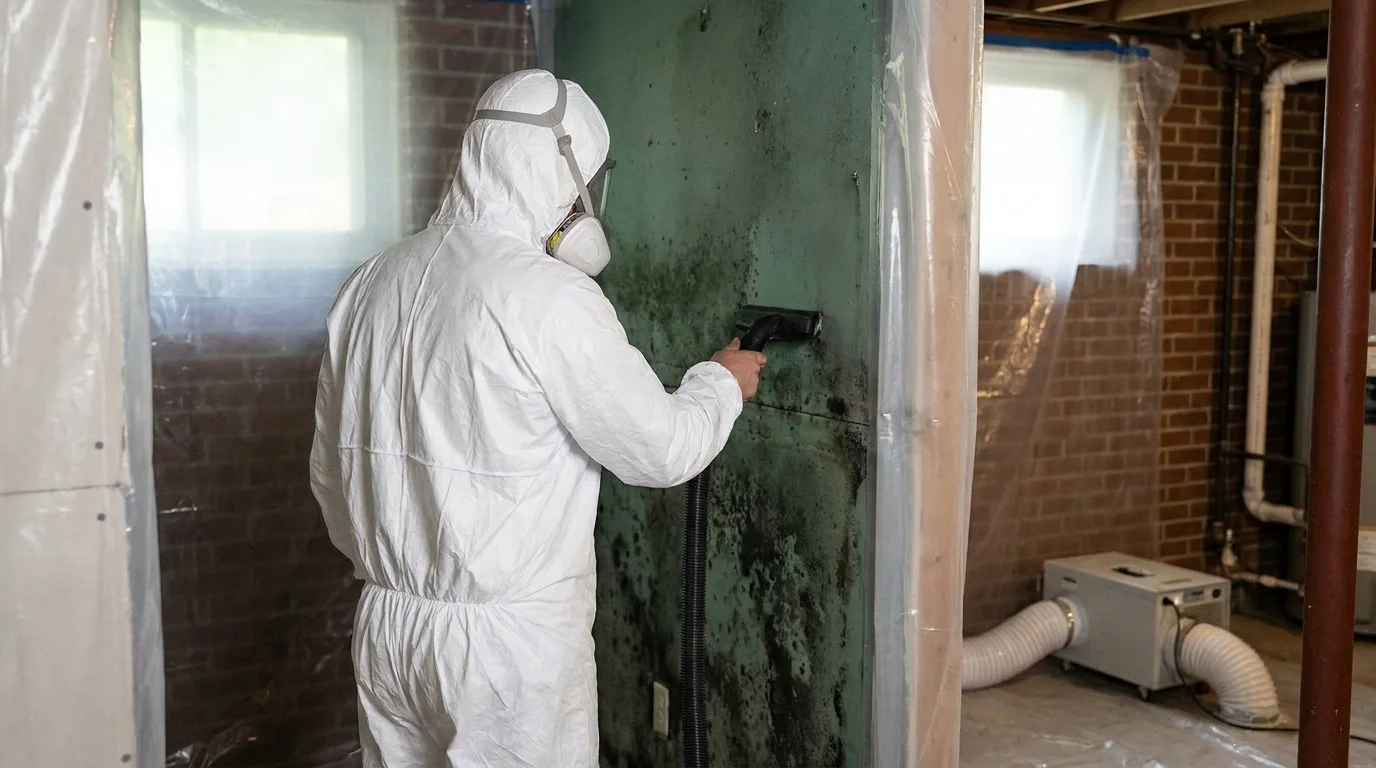
Every remediation starts with containment, not cleaning. Before any material is disturbed, the affected area is isolated with polyethylene sheeting and negative air pressure is established using HEPA-filtered air scrubbers. This step matters especially in older Des Plaines homes where HVAC ductwork often runs through finished basements, without proper containment, spores can travel through the system and seed new growth in unaffected rooms.
Once containment is in place, affected porous materials, drywall, insulation, wood framing that has lost structural integrity, are removed and bagged for disposal. Non-porous surfaces are cleaned with EPA-registered antimicrobial agents. Structural lumber that tests positive for surface mold but remains structurally sound is treated and encapsulated rather than removed, which keeps the scope of reconstruction manageable. Throughout the process, moisture readings are taken at multiple depths using pin and pinless meters to confirm that the underlying cause has been resolved, not just the visible growth.
Post-remediation, air quality verification confirms that spore counts in the treated area have returned to or below outdoor ambient levels. This step protects the homeowner and creates documentation that is useful for insurance claims and future real estate disclosures.
Des Plaines Insurance Coordination
Mold claims in Illinois can be complicated. Many standard homeowner policies cover mold remediation only when it results directly from a covered peril, a sudden pipe burst, for example, and exclude mold that developed from long-term seepage or deferred maintenance. That distinction matters when filing a claim, and the documentation gathered during remediation is often what determines whether a carrier approves or denies coverage.
Dry Bros documents the loss thoroughly: moisture mapping, photographic evidence of affected materials before removal, and written scope notes that describe the likely origin and timeline of the moisture intrusion. That package gives your adjuster what they need to make a coverage determination. We work with most major carriers and can communicate directly with your adjuster so you are not translating between technical findings and insurance language on your own.
Local Note
Des Plaines has a significant number of homes with crawl spaces rather than full basements, a construction style common in neighborhoods developed in the 1950s on lots where full excavation was cost-prohibitive. Crawl spaces in this area tend to accumulate standing water after heavy rain because the soil grade often pitches slightly toward the foundation rather than away from it. Mold in a crawl space is frequently misidentified as dirt or efflorescence until it’s tested. If you’re seeing white or gray fuzzy growth on floor joists or vapor barrier plastic, or if your first floor has an unexplained musty smell that intensifies in spring, a crawl space inspection is worth doing before the problem migrates upward into the living space.
If you’re dealing with visible mold growth, a persistent musty odor, or recent water damage in a Des Plaines home, call Dry Bros Water & Fire Restoration at (877) 379-2767. Prompt remediation limits both the health exposure and the scope of reconstruction, and in a housing market where disclosure requirements apply to known mold conditions, getting it documented and resolved correctly protects your investment.
Mold Remediation in Des Plaines: Service Coverage
Frequently Asked Questions
How fast can you arrive for mold remediation in Des Plaines?
Does the Des Plaines River flooding history affect mold risk for homes near the river corridor?
Are the older postwar homes common in Des Plaines harder to remediate than newer construction?
How does mold remediation in a Des Plaines crawl space differ from a full basement job?
Will my Illinois homeowner's insurance cover mold remediation in Des Plaines?
How long does a typical mold remediation take in a Des Plaines home?
Mold Remediation response in Des Plaines
Most Des Plaines calls see a technician on-site within 60 minutes from our Chicago headquarters.