
Mold Remediation in Naperville
Mold remediation in Naperville, IL. Insurance billing accepted. Call (877) 379-2767.
Our technicians are dispatched from our Chicago, IL headquarters and are typically on-site in Naperville within 60 minutes of your call.
Naperville’s wet winters and humid summers create a moisture cycle that many homeowners don’t think about until they smell something musty behind a finished basement wall or notice discoloration spreading along a ceiling seam. The DuPage County climate, with freeze-thaw cycles that stress foundation seals and summer humidity that lingers indoors, gives mold a reliable foothold in homes across the city, from newer subdivisions near the Riverwalk corridor to older ranch-style homes closer to downtown. When mold takes hold, it moves fast: colonies can establish within 24 to 48 hours of sustained moisture exposure, and what looks like surface staining often runs deeper into drywall, insulation, and framing.
Why Naperville Properties See Mold Issues
Naperville sits in a region where clay-heavy soils slow drainage after heavy rain, and that water has to go somewhere. Basement slab edges, window wells, and the seams around egress windows are common entry points, especially in the split-level and ranch homes built throughout the 1970s and 1980s that make up a large share of the city’s residential stock. Finished basements are nearly universal in this part of the Chicago metro, which means moisture intrusion often happens behind drywall and carpet before anyone notices.
Sump pump failures during spring storms are a recurring cause of mold in Naperville. When a pump fails during a heavy rain event and several inches of water sit on a basement floor for even a few hours, the materials underneath, carpet pad, OSB subfloor, the bottom plate of framed walls, absorb enough moisture to sustain mold growth for weeks, even after the visible water is gone. Newer construction in master-planned communities on the city’s western edges can face similar issues if grading has settled and directs runoff toward the foundation rather than away from it.
Our Mold Remediation Process in Naperville
Effective mold abatement isn’t a matter of spraying a surface and calling it done. The process starts with a thorough assessment, using moisture meters and thermal imaging to locate wet building materials that aren’t visible to the naked eye. Surface mold is almost always a symptom, not the source.
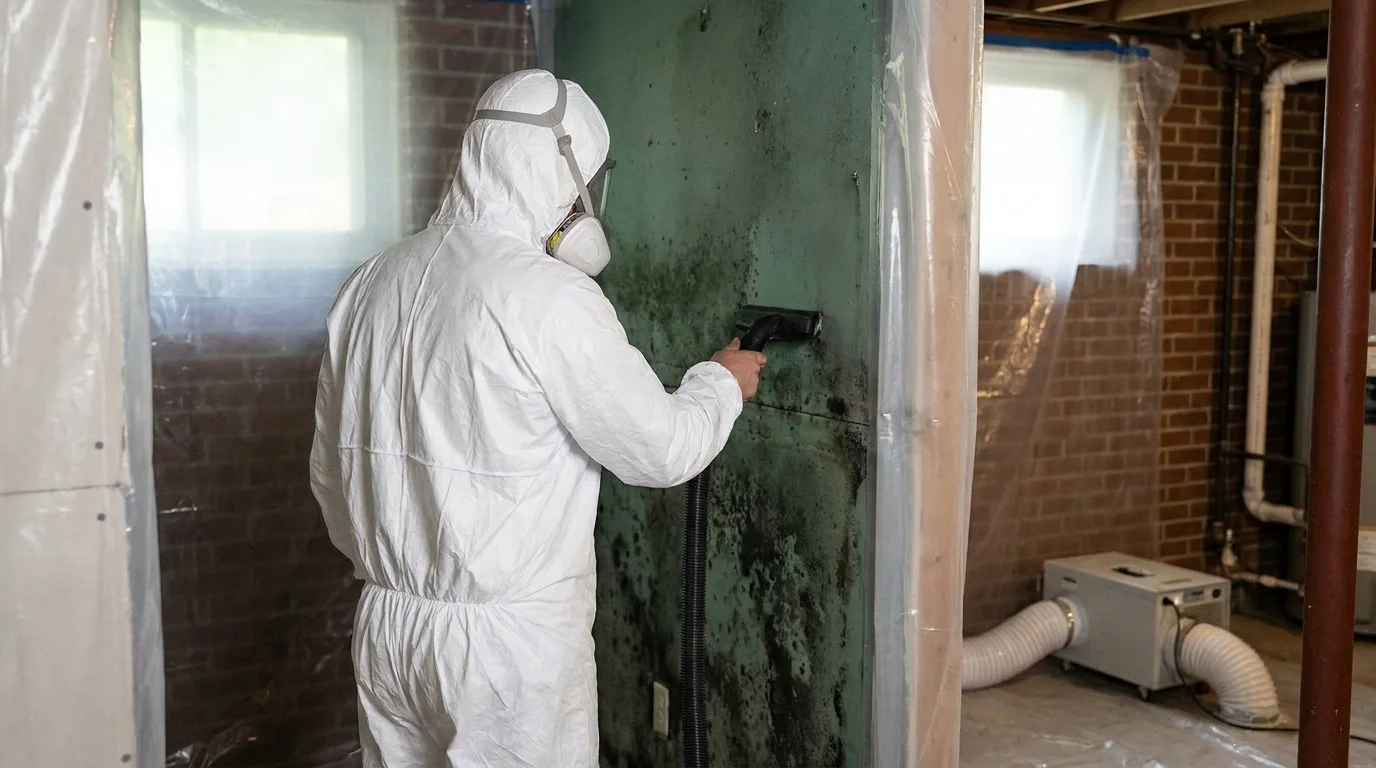
Once the affected area is mapped, containment goes up: heavy-gauge poly barriers and negative air pressure keep spores from migrating to unaffected parts of the home during removal. Contaminated drywall, insulation, and framing are removed and bagged before the structural cavity is treated and dried to target moisture levels. Air scrubbers with HEPA filtration run continuously throughout the process to capture airborne particulate.
Drying doesn’t stop when the visible work is done. Structural materials are monitored until they reach acceptable moisture content, because releasing containment before materials are genuinely dry is how mold comes back. In Naperville’s finished basements, where framed walls often sit directly against concrete, that drying phase deserves patience, not shortcuts.
Naperville Insurance & HOA Coordination
Mold claims in Illinois can be complicated. Whether coverage applies often depends on the documented cause: a sudden pipe failure is typically covered; long-term seepage that went unreported usually isn’t. Thorough documentation from the start, photographs, moisture readings, written scope, is what gives an adjuster what they need to process the claim accurately.
For homeowners in Naperville’s HOA communities, remediation work that involves common walls, shared mechanical systems, or exterior penetrations may require HOA notification or approval before work begins. Some associations also require post-remediation air quality testing by an independent party before a unit can be reoccupied. Dry Bros can coordinate directly with your association’s property manager to make sure the process doesn’t stall over paperwork.
Local Note
Naperville has a significant number of homes built in the late 1970s through the mid-1990s that used paper-faced drywall in basement finishing, a material that is particularly hospitable to mold when it stays damp. Unlike the moisture-resistant drywall products used in more recent construction, standard paper-faced board wicks water up from the bottom and holds it, often showing no visible sign of a problem until the mold colony is well established. If your home was finished during that era and has had any water intrusion, the affected drywall almost certainly needs to come out rather than be treated in place.
Call Dry Bros Water & Fire Restoration at (877) 379-2767 to schedule a mold assessment in Naperville. The sooner the moisture source and affected materials are identified, the more contained the remediation scope, and the sooner your home is back to normal.
Mold Remediation in Naperville: Service Coverage
Frequently Asked Questions
How fast can you arrive for mold remediation in Naperville?
How does Naperville's clay soil affect mold risk in my home?
My Naperville home has a finished basement that flooded during a spring storm. How long before mold becomes a concern?
Does Naperville have specific permit or notification requirements for mold remediation work?
Our Naperville HOA is asking for documentation after mold remediation. What does that typically include?
What's the difference between mold removal and mold remediation, and why does it matter for my Naperville home?
Will my homeowners insurance cover mold remediation in Naperville?
Mold Remediation response in Naperville
Most Naperville calls see a technician on-site within 60 minutes from our Chicago headquarters.