
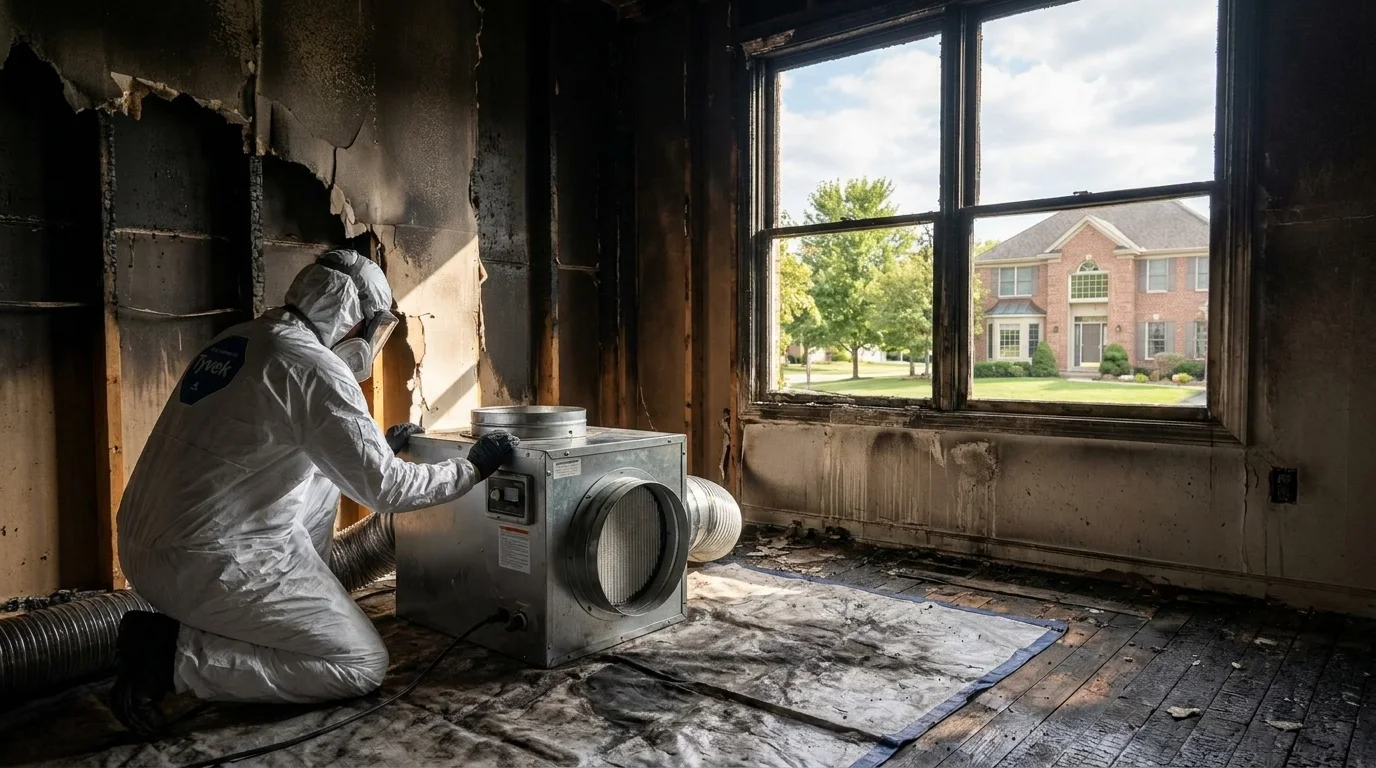
Fire Damage Restoration in Oak Park
Fire damage restoration in Oak Park, IL. Insurance billing accepted. Call (877) 379-2767.
Our technicians are dispatched from our Chicago, IL headquarters and are typically on-site in Oak Park within 60 minutes of your call.
Oak Park’s architectural identity is inseparable from its building stock, block after block of late-Victorian and Prairie-style homes, many with original balloon-frame construction, wood-lath interiors, and decorative millwork that took craftsmen weeks to install. When fire moves through a structure like that, it doesn’t just char surfaces. Smoke infiltrates every cavity between the studs, soot settles into plaster cornices, and the odor embeds itself in materials that modern drywall simply doesn’t have. Fire damage restoration here demands a different level of care than a tract-built suburb, and that’s exactly the kind of work Dry Bros Water & Fire Restoration is equipped to handle.
Why Oak Park’s Housing Stock Shapes Fire Damage Recovery
The homes that make Oak Park architecturally significant are also the ones that complicate fire cleanup. Balloon-frame construction, common in houses built before the 1940s, lacks the fire-blocking between floors that platform-frame homes have. That means smoke and heat travel vertically through wall cavities with very little resistance, depositing soot and residue on surfaces far from the original burn area. You might have a kitchen fire and find smoke damage in a second-floor bedroom that shares no obvious path with the source.
Oak Park also has a substantial number of homes with original horsehair plaster walls. Plaster is dense and porous in a way that drywall isn’t, it holds odor compounds deep in the substrate, and surface cleaning alone won’t eliminate them. Restoration crews who aren’t familiar with this material often miss the source of persistent smoke smell weeks after a job is “complete.”
Added to this is the age of the electrical systems in many of these properties. Knob-and-tube wiring, while often updated, still exists in portions of older homes, and post-fire electrical inspections coordinated with the Village of Oak Park’s building department are a standard part of the recovery timeline before reconstruction can begin.
Our Fire Damage Restoration Process in Oak Park
Every fire loss starts with an honest assessment of what the structure has actually absorbed, not just what’s visibly burned. The process typically moves through these stages:
Emergency stabilization comes first: boarding openings, tarping the roof if there’s been structural compromise from firefighting water, and securing the property against weather and unauthorized entry. Oak Park winters are unforgiving, and a structure open to the elements in January can develop secondary water and freeze damage within hours.
Controlled demolition and debris removal follows. Charred framing, saturated insulation, and unsalvageable materials come out carefully, with attention paid to what’s worth preserving. In a home with original built-ins, pocket doors, or decorative trim, the goal is to remove only what cannot be saved.
Soot and smoke residue cleaning is where the work gets technical. Dry soot, wet soot, and protein residue from kitchen fires each require different chemistry. Protein residue, the thin, nearly invisible film left by grease fires, is particularly stubborn and is one of the most common sources of odor complaints months after a fire.
Odor neutralization in older plaster homes often requires thermal fogging or hydroxyl treatment to reach into wall cavities, not just surface application of deodorizers.
Structural drying addresses the water introduced by suppression, fire hoses push significant volume into a structure, and that moisture has to be extracted and dried before reconstruction begins.
Reaching Oak Park from Chicago
Dry Bros operates out of Chicago, and Oak Park sits directly on the western edge of the city along the Eisenhower Expressway (I-290) corridor. The Harlem Avenue exit puts crews into the heart of Oak Park quickly, and the grid street layout, a hallmark of the village’s planned development, makes navigation straightforward once on the ground. The neighborhoods closest to the Chicago border, including the streets running off Oak Park Avenue near the CTA Green Line stations, are the most accessible from the city; properties deeper into the village near Ridgeland or Lombard Avenues add only a few minutes to the drive.
Oak Park Insurance Coordination
Fire claims in Oak Park typically involve standard homeowners’ policies, but the presence of historically significant or architecturally notable materials can create friction with adjusters who are pricing replacements at commodity rates. Original wood windows, plaster moldings, and period millwork cost significantly more to restore or replicate than their modern equivalents, and that gap has to be documented carefully to support a fair settlement.
Dry Bros provides detailed scope-of-loss documentation, photographs, moisture readings, material inventories, formatted to work within the claims process. We communicate directly with adjusters so you’re not translating between your contractor and your carrier during an already stressful period.
Local Note
In Oak Park’s older balloon-frame homes, fire and smoke often travel into the attic through open stud bays before the fire department arrives. Attic insulation, particularly the blown-in cellulose common in energy retrofits done over the past few decades, absorbs smoke odor deeply and is almost never salvageable after a significant fire. Homeowners are sometimes surprised to learn the attic requires full insulation removal and replacement even when the fire itself was confined to a lower floor. It’s one of the details that separates a thorough restoration scope from one that leaves a persistent smell behind.
If you’re dealing with fire damage to a home or commercial property in Oak Park, call Dry Bros Water & Fire Restoration at (877) 379-2767. The sooner the assessment begins, the more options you have for preserving what matters.
Fire Damage Restoration in Oak Park: Service Coverage
Frequently Asked Questions
How fast can you arrive for fire damage restoration in Oak Park?
How does balloon-frame construction in Oak Park's older homes affect the scope of fire damage restoration?
Does the Village of Oak Park require permits or inspections before fire damage reconstruction can begin?
Oak Park has a lot of homes with original plaster walls, does that change how smoke odor is treated?
What's the difference between dry soot and wet soot, and which is more common in Oak Park residential fires?
Can Dry Bros help with insurance documentation for fire damage to a historically or architecturally significant home in Oak Park?
Fire Damage Restoration response in Oak Park
Most Oak Park calls see a technician on-site within 60 minutes from our Chicago headquarters.