
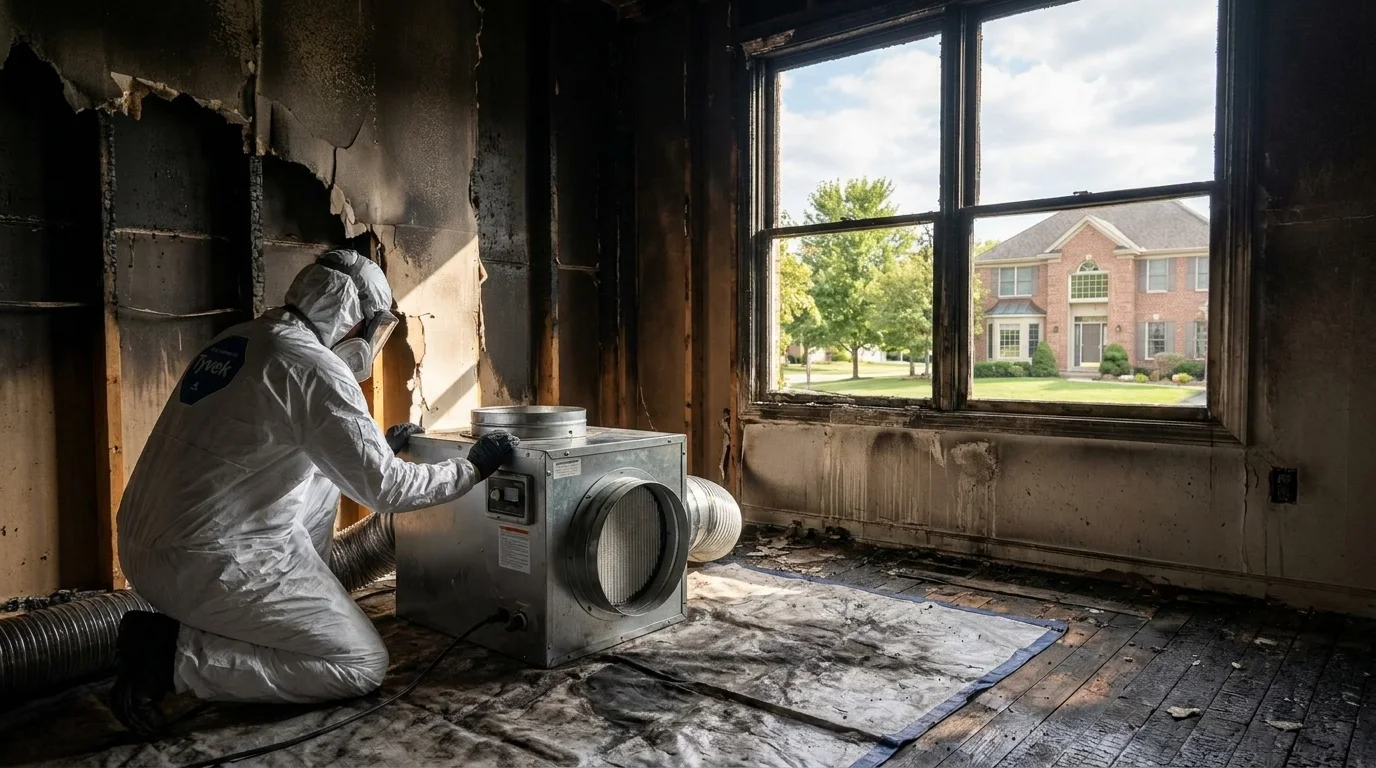
Fire Damage Restoration in Evanston
Fire damage restoration in Evanston, IL. Insurance billing accepted. Call (877) 379-2767.
Our technicians are dispatched from our Chicago, IL headquarters and are typically on-site in Evanston within 60 minutes of your call.
Evanston’s dense mix of century-old brick two-flats, Victorian-era single-families, and mid-century apartment buildings creates a particular challenge after a house fire: smoke and soot don’t just coat surfaces, they penetrate plaster lathe, settle into original hardwood subfloors, and travel through the kind of interconnected duct systems that were standard before modern HVAC zoning. If you’ve just had a fire in Evanston, the visible char is rarely the whole story. Dry Bros Water & Fire Restoration responds from Chicago to help property owners cut through the confusion and start the recovery process the right way.
Why Evanston’s Building Stock Shapes Fire Damage Recovery
A large share of Evanston’s residential housing was built before 1950, and that construction era comes with specific fire damage patterns that newer suburban homes don’t share. Plaster-and-lath walls, common throughout older Evanston neighborhoods, absorb smoke odor compounds deep into the substrate, far deeper than drywall ever would. That means surface cleaning alone won’t eliminate the smell. The char may stop at the studs, but the odor keeps traveling.
Older balloon-frame construction, which appears frequently in Evanston’s pre-war housing stock, allows fire and smoke to travel vertically inside wall cavities with very little resistance. A kitchen fire on the first floor can push smoke into second-floor walls and attic spaces without leaving obvious scorch marks at the entry points. Thermal imaging and cavity inspection are essential in these buildings, not optional.
Evanston also sits along Lake Michigan, and the lake-effect humidity that defines the city’s climate from late fall through early spring means post-fire moisture, from suppression water and steam, lingers longer than it would inland. Wet insulation and saturated plaster in a cold, humid environment are conditions where secondary mold growth can begin within days if drying isn’t started promptly.
Our Fire Damage Restoration Process in Evanston
Every fire loss is different, but the sequence of work follows a logic built around what fire actually does to a structure.
The first step on-site is a full damage assessment, not just the burned area, but the smoke migration path. In a typical Evanston two-flat or greystone, that means checking the unit above, the shared stairwell, and any attic access, because smoke rises and finds every gap.
Once the scope is documented, board-up and tarping secures the structure. Evanston winters are not forgiving, and an unsecured roof opening or broken window after a fire can cause water and freeze damage that compounds the original loss significantly.
Content pack-out comes next for salvageable belongings, furniture, clothing, documents, which are catalogued, transported, and cleaned off-site using ozone treatment and thermal fogging where appropriate. Meanwhile, structural drying begins to address suppression water before demolition of non-salvageable materials.
After demolition, smoke residue cleaning of framing, masonry, and mechanical systems precedes any reconstruction. Soot is acidic, it continues to etch metal fixtures, stain masonry, and degrade surfaces the longer it sits. Speed through this phase matters.
Reaching Evanston from Chicago
Dry Bros operates out of Chicago, and Evanston is a direct run north, up Sheridan Road along the lakefront or via the Edens Spur to the city’s western edges. Evanston’s grid is well-connected, and we’re familiar with navigating both the denser central blocks near downtown Evanston and the quieter residential streets further north and west. Scheduling is handled by phone at (877) 379-2767.
Evanston Insurance Coordination
Fire damage claims are among the most complex residential insurance events a homeowner faces. The documentation burden is real: carriers want itemized content lists, photo evidence of structural damage, moisture readings, and scope-of-work estimates before they authorize repairs.
We prepare that documentation as part of the job, photographs, moisture logs, written scope, so you’re not assembling it yourself while also dealing with displacement and stress. We communicate directly with adjusters and can work within the carrier’s preferred vendor framework or independently, depending on your policy.
For Evanston properties with condo association or HOA structures, it’s worth confirming early whether the loss falls under the master policy or your individual unit coverage. That distinction affects who controls the scope of repairs and which contractor the association may require.
Local Note
Evanston’s older greystone and brick courtyard buildings, common in the central and southern parts of the city, often have shared mechanical chases and common-area ductwork that connects individual units. After a fire in one unit, smoke odor can migrate into adjacent units through these shared systems even when the fire itself was contained. Property managers dealing with a fire loss in one of these buildings should plan for odor assessment in neighboring units, not just the unit of origin. Ignoring the shared systems is one of the more common reasons a fire restoration job gets called back for persistent smell complaints weeks after the work is done.
If you’re dealing with fire or smoke damage in Evanston, whether it’s a single-family home, a two-flat, or a multi-unit building, call Dry Bros Water & Fire Restoration at (877) 379-2767. We’ll assess the full scope of the damage, not just what’s visible, and walk you through a clear recovery plan from the first call.
Fire Damage Restoration in Evanston: Service Coverage
Frequently Asked Questions
How fast can you arrive for fire damage restoration in Evanston?
Does Evanston's older housing stock make fire damage restoration more complicated than in newer suburbs?
How does Lake Michigan's climate affect post-fire drying in Evanston?
Can smoke from a fire in one unit of an Evanston courtyard building affect neighboring units?
What does the fire damage restoration process actually look like from the first call to the end of the job?
How does insurance documentation work for a fire loss in Evanston, and do you work with adjusters directly?
Fire Damage Restoration response in Evanston
Most Evanston calls see a technician on-site within 60 minutes from our Chicago headquarters.