For water damage restoration in Chicago, call Dry Bros at (877) 379-2767. The company answers calls 24/7, is licensed and insured, and is locally owned and operated in the city.
If you’re reading this with water actively spreading across a floor, that’s the number you need. The rest of this page is for the five minutes before help arrives and the decisions that come right after: whether this is a plumber’s job or a restoration job, what to do with the water in the meantime, and when to loop in your insurance company.
Is this a restoration company call, a plumber call, or a 911 call?
Call a water damage restoration company when water has already soaked flooring, drywall, or belongings and needs to be removed and dried out. Call a plumber separately (or at the same time) if the source of the water is still flowing and hasn’t been stopped yet.
Some situations need a different first call entirely. If you smell gas, see sparking outlets, or water is pooling near an electrical panel, shut off power at the breaker if it’s safe to reach and call 911 or ComEd before anyone wades into standing water. If the water is coming from a sewer backup or a floor drain, treat it as contaminated, also called Category 3 or black water under the IICRC’s ANSI/IICRC S500 standard, and keep kids and pets out of the room until a crew arrives.
A burst supply line or a failed water heater is usually Category 1, clean water, at least at first. It doesn’t stay clean for long once it sits on carpet or soaks into drywall, which is part of why the clock matters. Chicago’s older two-flats and brick bungalows often have original cast-iron or galvanized plumbing, and a hidden slow leak behind a wall can look minor until the drywall finally gives.
What should you do before the crew gets there?
Stop the water at the source if you can safely reach the main shutoff valve, then move furniture and valuables off the wet floor. Beyond that, don’t try to dry the space yourself with household fans alone.
Take photos and a short video of the standing water and any damaged belongings before you move anything. This documentation is what an adjuster will ask for later, and it’s much easier to capture in the moment than to reconstruct afterward. If the water is clean (Category 1) and shallow, soaking up what you can with towels is fine. If it’s gray or black water, from an appliance backup, a toilet overflow, or a sewer line, stop touching it and wait for a crew with the right PPE.
Our site walks through this in more detail in what to do in the first 24 hours after water damage if you want the longer checklist.
What actually happens when you call a restoration company in Chicago?
The first call is a short intake: your address, what kind of water this is, roughly how large an area is affected, and whether the power or gas is still on. From there a technician schedules an on-site assessment to confirm the scope before any equipment comes off the truck.
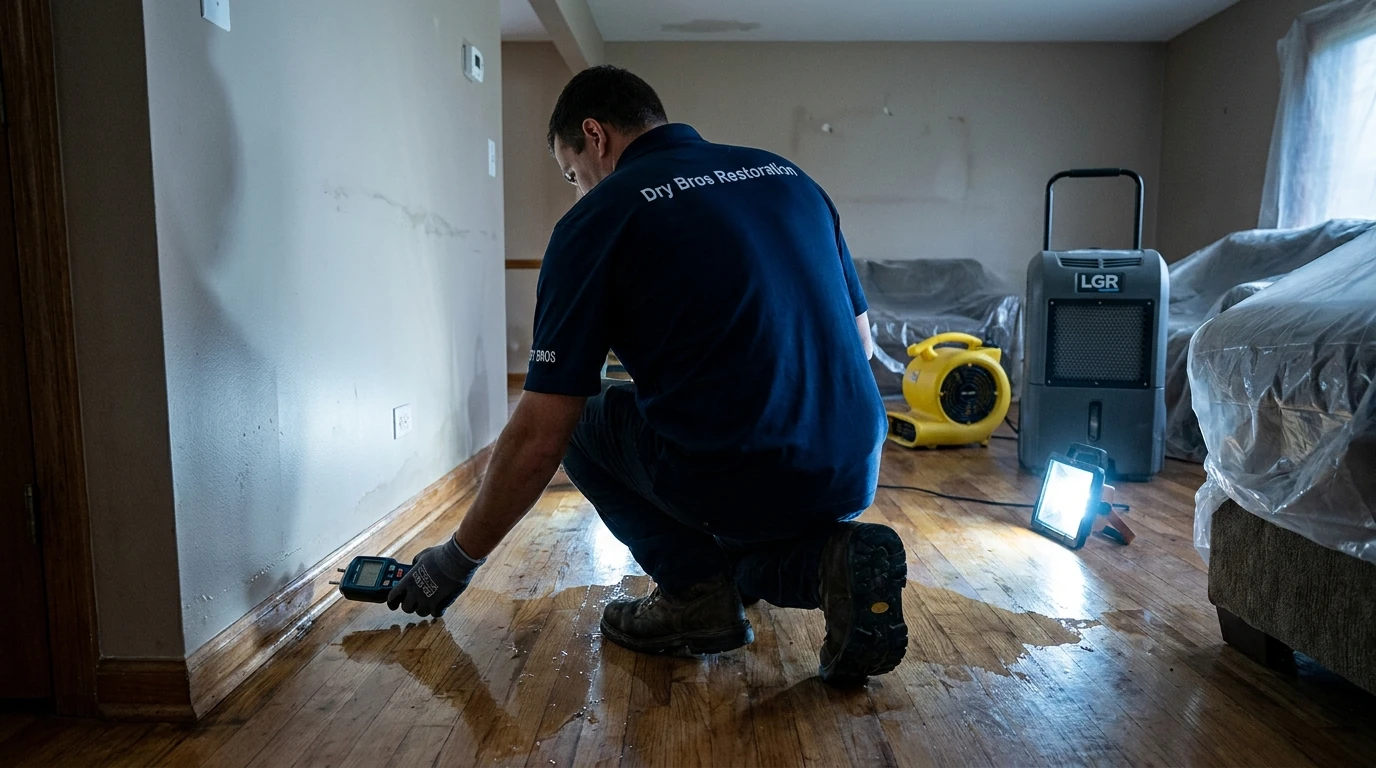
On arrival, the crew checks moisture levels in the walls, floors, and subfloor with a moisture meter, not just what’s visible on the surface. That reading determines what gets dried in place versus what has to come out, like soaked baseboards or saturated carpet pad. Extraction equipment and air movers go in first, with a dehumidifier sized to the room, dried to the ANSI/IICRC S500 standard rather than eyeballed. A written scope of work, with photos and moisture readings, is what you’ll hand to your insurance company.
When should you call your insurance company?
Call your insurance company after you’ve stopped the water and contacted a restoration company, not before. Most policies require you to mitigate further damage promptly, and a documented start time on the mitigation helps your claim rather than hurting it.
Most homeowners policies cover sudden, accidental water damage, a burst pipe or a failed appliance hose, but not gradual leaks or long-term seepage. A sewer or sump pump backup is typically only covered if you’ve added a water backup endorsement to your policy. Our post on whether homeowners insurance covers water damage breaks down what’s usually in and out of a standard policy, and the Insurance Information Institute is a good neutral reference if you want the industry-wide view.
If you’re still deciding who to call, the short version holds: stop the source if it’s safe, document what you see, and call Dry Bros at (877) 379-2767 to get a crew and a moisture reading on the schedule before the water decides the next 48 hours for you.